CBAM 2026 in Practice: TARIC & Authorisation
Key Takeaways
- This guide covers guide reporting requirements based on IR (EU) 2025/2621 and EU Regulation 2023/956
- All emission factors and CN codes referenced are verified against the latest EU implementing regulations
- Practical steps and common mistakes are drawn from hands-on implementation experience with the CbamTrack platform
From the team behind CbamTrack
We built this guide based on hands-on experience implementing CBAM compliance for SME importers. The calculations and workflows described here power our own platform — this is not theory, it's what we ship.
The definitive phase in one page
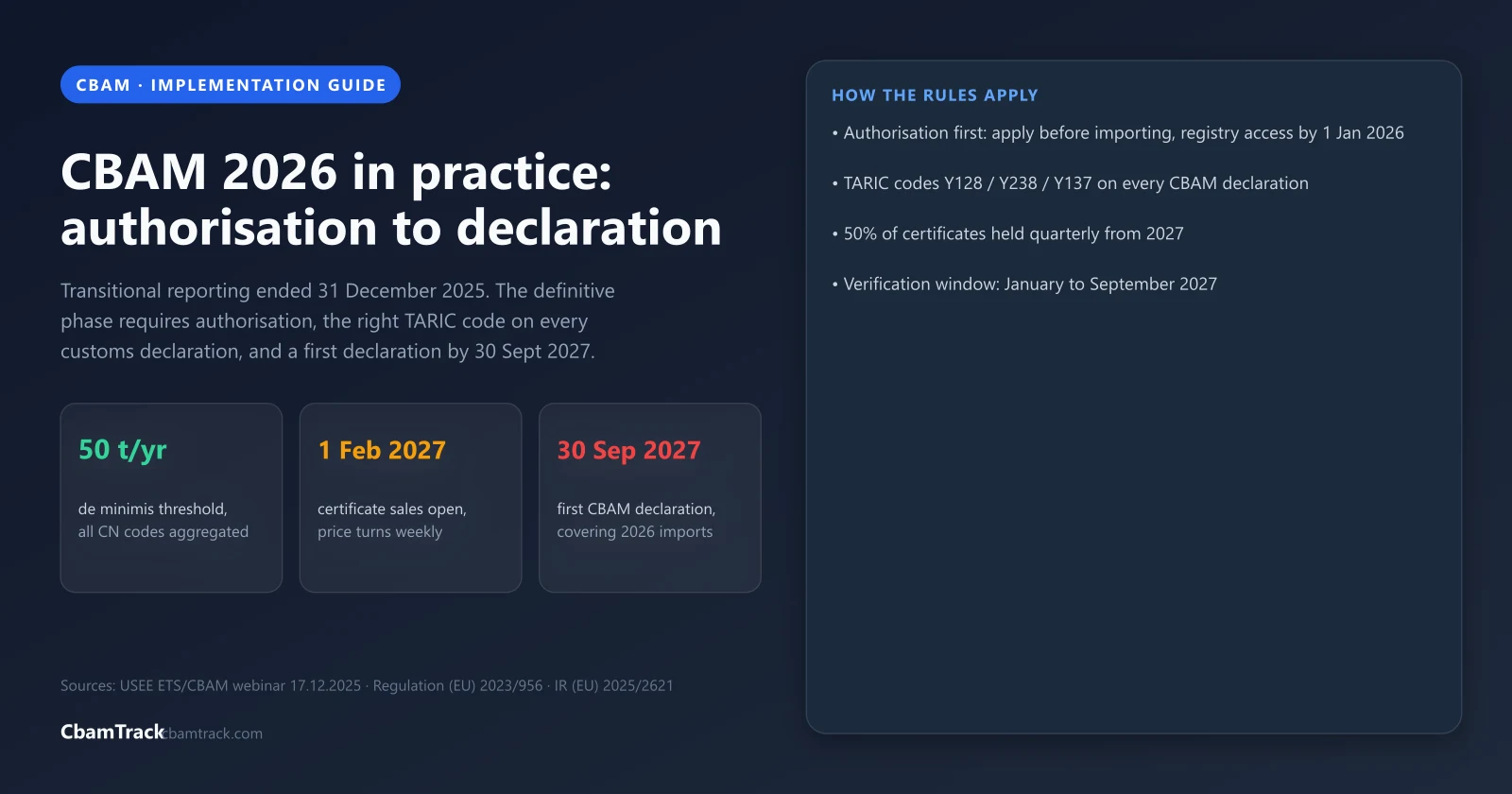
CBAM's transitional phase ended 31 December 2025. From 1 January 2026, imports of CBAM goods require authorisation, certificates and declarations. This guide condenses the practical mechanics, based on the Luxembourg Administration de l'environnement's ETS/CBAM webinar (17 December 2025).
1. Authorisation: the first priority
| Requirement | Detail |
|---|---|
| Who | Importers or indirect customs representatives established in an EU Member State |
| Threshold | Cumulative 50 tonnes/year of CBAM goods (annual calculation) |
| Below threshold | No authorisation, no reports, no certificates needed for 2026 |
| Deadline | Apply before importing; at minimum request access to the registry before 1 January 2026 |
| Guarantee | Required if established for less than 2 years |
"The authorisation should be a main priority to get." Luxembourg Administration de l'environnement, USEE ETS/CBAM webinar (17 Dec 2025)
Customs track this: authorities monitor imports against the 50-tonne threshold. If you exceed it, obligations apply to all goods imported that year.
2. TARIC codes: getting the customs declaration right
When declaring a CBAM CN code from a non-EEA origin, you must add a supporting TARIC document code and account number:
| TARIC code | Meaning |
|---|---|
| Y128 | Importer has a CBAM authorisation (needs EORI + authorisation number) |
| Y238 | Importer applied for authorisation but doesn't have it yet (use applicant number) |
| Y137 | Importer has no authorisation but imports under 50 t/year (enter "NA") |
| Y134 | Imports from Büsingen, Heligoland, Livigno |
"If you fulfill the CBAM criteria but do not add the TARIC code and reference number, you will get an error panel, indicating that you must provide it." USEE ETS/CBAM webinar (17 Dec 2025)
Key rules:
- EU/EEA origin (for example, EU or Norway) means no TARIC code needed
- The number used (the importer's or the indirect representative's) carries responsibility for certificates and reports
- If the importer is established outside the EU, the indirect customs representative is liable for CBAM
3. The registry timeline
| Date | Registry milestone |
|---|---|
| 1 January 2026 | Imports tracking module live (O3CI producer module already live) |
| 1 July 2026 | Price calculator module |
| 1 January 2027 | Annual report module |
| 1 February 2027 | Common central platform for certificate management |
| 30 September 2027 | First CBAM declaration (covering 2026 imports) |
| 31 December 2027 | General evaluation of CBAM |
4. Certificate purchase and surrender
| Rule | Detail |
|---|---|
| Unit | 1 certificate = 1 tonne CO2e |
| Price 2026 | Quarterly (based on EU ETS auction close); weekly from 1 February 2027 |
| Purchase | From 1 February 2027 on the common central platform |
| Quarterly holding | 50% of required certificates (based on default values) by end of each quarter |
| Surrender | First declaration by 30 September 2027 for 2026 imports |
| Repurchase | Requests by 31 October 2027; cancellation of excess 1 November 2027 |
Worked example (from the webinar): aluminium tube/pipe fittings (CN 76090000) from Indonesia
| Input | Value |
|---|---|
| Unit quantity | 120 t |
| Embedded benchmark | 1.493 tCO2e/t (CN 7609, tube/pipe fittings) x 0.975 = 1.4557 |
| Embedded emissions | 2.277 tCO2e/t |
| Free allocation remaining (2026) | 97.5% |
| EU ETS price | €85 |
| Certificates | 99 |
| Cost | €8,415 |
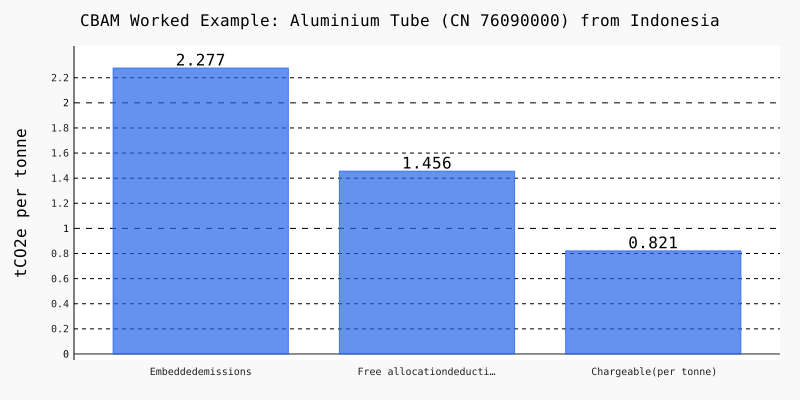
How the numbers fit: certificates = (2.277 minus 1.4557 tCO2e/t) x 120 t = about 99; cost = 99 x €85 = €8,415.
5. Verification: the 2027 window
| Item | Detail |
|---|---|
| What | Annual verification of a year's emissions by an accredited verifier |
| When | After 1 January 2027 and before 30 September 2027 |
| Who | Verifier accredited by an EU accreditation body |
| Site visits | Expected norm; can be waived under specific conditions |
| Default values | Used when no verified actual data can be provided |
Current uncertainty: the implementing act on verifier accreditation conditions was still pending at the webinar date; reduced markups were applied partly for this reason (see our default values post).
6. Default values, markups and benchmarks (quick reference)
- Markups: +10% (2026), +20% (2027), +30% (2028); no markup on electricity; 1% for fertilisers
- Benchmarks: based on top 10% of EU installations; revised CBAM benchmarks apply from 1 January 2027
- CBAM factor: 2.5% (2026) rising to 100% (2034); free allocation falls from 97.5% to 0%
- CSCF (cross-sectoral correction factor): currently 100%, no reduction applied
The short version
- Authorisation is the priority: apply before importing; request registry access before 1 January 2026
- Use the right TARIC code (Y128/Y238/Y137) on every CBAM customs declaration
- 50% quarterly holding of certificates required from 2027
- Verification window: January to September 2027; book verifiers early
- First declaration due 30 September 2027 for 2026 imports
Related: CBAM Reporting Deadlines | How to Submit Your CBAM Report | Free CBAM Reporting Checklist
Frequently asked questions
What if I applied for authorisation but haven't got it yet?
Use TARIC code Y238 with your applicant number. You can import while the application is processed (mirrored in national rules, for example Ireland's provisional authorisation until a decision).
When can I buy CBAM certificates?
From 1 February 2027 on the common central platform. In 2026, prices are published quarterly but certificates for 2026 emissions are bought in 2027.
Do I need a verifier if I use default values?
No. Default values don't require verification. Actual data must be verified between January and September 2027.
Regulation status
| Field | Value |
|---|---|
| Last reviewed | 2026-09-15 |
| Based on | Regulation (EU) 2023/956, IR (EU) 2025/2621, USEE ETS/CBAM webinar (17 Dec 2025) |
| Applies to | CBAM permanent phase (2026+) |
References
- Luxembourg Administration de l'environnement, CBAM
- European Commission, CBAM
- French Ministry, CBAM (MACF) calculator
- EU Regulation 2023/956
- IR (EU) 2025/2621
Last updated: September 2026 | Sources: USEE ETS/CBAM webinar 17.12.2025, Regulation (EU) 2023/956, IR (EU) 2025/2621
Important Financial Disclaimer
The financial figures, cost estimates, and compliance scenarios discussed in this article are for informational purposes only. Actual CBAM liability depends on your specific import profile, verified emission data, and regulatory interpretations. Consult a qualified CBAM advisor or customs professional before making compliance decisions.
This article was researched and written with AI assistance. Figures and regulatory references are cross-checked against official EU sources (EUR-Lex, European Commission CBAM page) and updated when the rules change.
R. Emrah Gökkaya
I built CbamTrack because I saw SME exporters struggling with spreadsheets and confusing regulations. Every article here reflects what I've learned implementing IR 2025/2621-compliant calculations, integrating live EU ETS pricing, and building the emission factor database that powers our platform.
View full author bio →Ready to simplify your CBAM compliance?
Subscribe today and generate your first CBAM report in minutes.