Aluminium CBAM: Direct Emissions Guide
Key Takeaways
- This guide covers industry guide reporting requirements based on IR (EU) 2025/2621 and EU Regulation 2023/956
- All emission factors and CN codes referenced are verified against the latest EU implementing regulations
- Practical steps and common mistakes are drawn from hands-on implementation experience with the CbamTrack platform
From the team behind CbamTrack
We built this guide based on hands-on experience implementing CBAM compliance for SME importers. The calculations and workflows described here power our own platform — this is not theory, it's what we ship.
Aluminium is one of the six CBAM-covered product categories. But there's a critical distinction that many importers get wrong: aluminium is an Annex II sector, which means only direct emissions are chargeable for CBAM certificate purposes. This guide covers what that means for your reporting and your costs.
"Under Regulation 2023/956 Article 7(1), indirect emissions for Annex II sectors — aluminium included — are reported for transparency but excluded from the CBAM chargeable calculation." — European Commission CBAM Regulation
Why Aluminium Importers Need to Pay Attention
With the EU importing roughly 4.5 million tonnes of primary aluminium each year, even small reporting errors add up. But the real risk is misunderstanding what counts toward your CBAM bill. Many importers assume their electricity-intensive smelting process drives their CBAM cost. Under Annex II, it does not.
Your CBAM liability for aluminium depends on direct emissions only — the emissions from the smelting process itself, not the power used to run it. Get this wrong and you could overpay by thousands or under-report and face penalties.
CN Codes for Aluminium Products
Aluminium products fall under CN Chapter 76:
| CN Code | Product Description |
|---|---|
| 7601 | Unwrought aluminium |
| 7602 | Aluminium waste and scrap |
| 7603 | Aluminium powders and flakes |
| 7604 | Aluminium bars, rods and profiles |
| 7605 | Aluminium wire |
| 7606 | Aluminium plates, sheets and strip |
| 7607 | Aluminium foil |
| 7608 | Aluminium tubes and pipes |
| 7609 | Aluminium tube fittings |
| 7610 | Aluminium structures |
| 7611–7616 | Other aluminium articles |
Most aluminium CBAM reporting falls under CN 7601 (unwrought) and CN 7604–7606 (semi-finished products).
The Annex II Distinction: Direct vs Indirect Emissions
This is the single most important concept for aluminium CBAM reporting. Regulation 2023/956 divides products into two categories:
| Category | Direct Emissions | Indirect Emissions (Electricity) |
|---|---|---|
| Annex I sectors (steel, cement, fertilisers) | Chargeable | Chargeable |
| Annex II sectors (aluminium, chemicals, hydrogen) | Chargeable | Reported only, not charged |
For aluminium importers, this means:
- Your CBAM cost is based on direct emissions only — what comes out of the smelter's own process
- Indirect emissions from electricity must still be reported in your quarterly declaration, but they do not add to your certificate cost
- But there's a catch coming in 2027 — the scope may expand, so keep tracking both
Direct Emissions by Smelting Technology
Aluminium smelting technology directly determines your direct emissions. The three main technologies have significantly different emission factors:
| Smelting Technology | Direct Factor (tCO₂e/t) | Common Regions |
|---|---|---|
| Pre-bake (Centre Worked Pre-Bake / CWPB) | 1.4–1.7 | Global standard — China, Canada, UAE |
| Søderberg (Horizontal Stud Søderberg / HSS) | 1.7–2.2 | Older plants — Russia, India |
| Inert Anode | <0.5 | Emerging technology — pilot stage |
Pre-bake technology is the global standard and produces lower direct emissions per tonne. Søderberg technology, found in older smelters, produces higher direct emissions due to less efficient anode consumption. Inert anode technology — still in development — would dramatically reduce direct emissions if commercialised.
Default Direct Emission Factors by Country
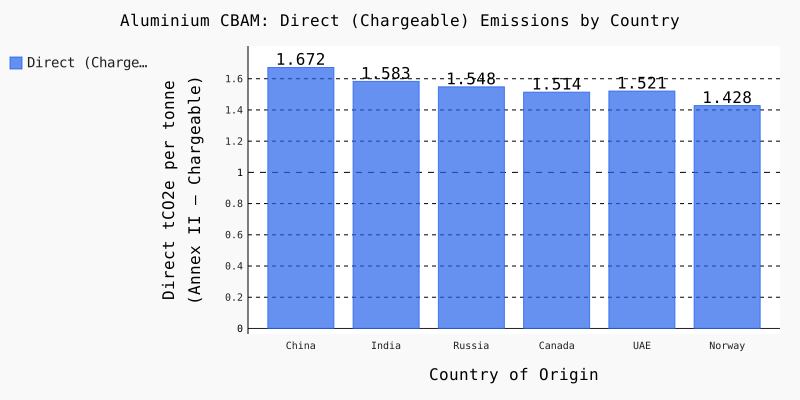
Every country's smelting fleet has a different mix of technologies, which means every country has a different direct emission factor. Here are the IR 2025/2621 default values:
| Country | Direct (tCO₂e/t) | Dominant Technology | CBAM Cost (per tonne, at €75/tCO₂e) |
|---|---|---|---|
| China | 1.672 | Pre-bake | €125.40 |
| India | 1.583 | Pre-bake | €118.73 |
| Russia | 1.548 | Søderberg / Pre-bake | €116.10 |
| Canada | 1.514 | Pre-bake (hydro-powered) | €113.55 |
| UAE | 1.521 | Pre-bake | €114.08 |
| Norway | 1.428 | Pre-bake (hydro-powered) | €107.10 |
Notice that the cost difference between the highest (China, €125/t) and lowest (Norway, €107/t) is only about €18 per tonne — roughly a 13% spread. This is very different from the misleading 60x spread people cite for total emissions.
What About Electricity and Indirect Emissions?
Aluminium smelting uses massive amounts of electricity (14,000–16,000 kWh per tonne). Coal-fired smelters can produce indirect emissions of 8–12 tCO₂e/t, while hydro-powered smelters are near zero. That 60x difference is real — but it does not affect your CBAM certificate cost.
| Energy Source | Indirect Factor (tCO₂e/t) | Reported? | Chargeable? |
|---|---|---|---|
| Coal-fired grid | ~8.0–12.0 | Yes | No (Annex II) |
| Natural gas | ~4.0–6.0 | Yes | No (Annex II) |
| Hydroelectric | ~0.1–0.5 | Yes | No (Annex II) |
| Nuclear | ~0.0–0.1 | Yes | No (Annex II) |
| Renewable | ~0.0–0.2 | Yes | No (Annex II) |
Under the current rules (2026), electricity source matters for your report but not your bill. This might change when the CBAM scope review happens in 2027–2028.
Data Requirements for Aluminium
For Each Product
- Specific CN code (8-digit)
- Quantity imported (tonnes)
- Smelting technology (pre-bake, Søderberg, inert anode) — this determines your direct factor
- Country of origin
- Supplier verification (if using actual values)
Documentation
- Smelter technology declarations
- Anode consumption records
- Supplier emission declarations
- Verification certificates (for actual values)
Common Aluminium-Specific Challenges
Confusing direct vs indirect — The most common compliance error is reporting indirect (electricity) emissions as chargeable and overpaying CBAM certificates. Always check: aluminium is Annex II, direct only.
Using the wrong technology factor — Each smelting technology has a different direct emission factor. Using a generic factor can lead to inaccurate reporting.
Country-specific factors vary less than you think — Unlike the 60x spread in total emissions, direct emission factors vary by only 13% between countries. The cost saving comes from accurate reporting, not from choosing a low-indirect country.
Upcoming scope changes — The European Commission is reviewing Annex II treatment. Indirect emissions may become chargeable after 2027. Track both now to avoid a compliance gap later.
FAQ
If I switch to hydro power, does my CBAM cost go down? Not under current rules. Aluminium is Annex II, so only direct emissions are chargeable. Switching electricity source reduces your reported total emissions but not your CBAM certificate cost. This may change in the 2027 scope review.
Can I use the EU average emission factor for aluminium? No. Aluminium factors are country-specific and technology-specific. Using incorrect factors will result in inaccurate reports.
How do I report aluminium imported from multiple countries? Report each shipment separately with its country-specific and technology-specific factors. Do not average across countries.
Does recycled aluminium have different reporting requirements? Secondary (recycled) aluminium has lower direct emissions. Different default factors apply.
Simplify Your Aluminium CBAM Reporting
Aluminium's Annex II treatment makes it unique among CBAM-covered sectors. CbamTrack automatically applies the correct country-specific and technology-specific direct emission factors, so you never confuse direct with indirect. Try it free or compare alternatives.
Important Financial Disclaimer
The financial figures, cost estimates, and compliance scenarios discussed in this article are for informational purposes only. Actual CBAM liability depends on your specific import profile, verified emission data, and regulatory interpretations. Consult a qualified CBAM advisor or customs professional before making compliance decisions.
This article was researched and written with AI assistance. Figures and regulatory references are cross-checked against official EU sources (EUR-Lex, European Commission CBAM page) and updated when the rules change.
R. Emrah Gökkaya
I built CbamTrack because I saw SME exporters struggling with spreadsheets and confusing regulations. Every article here reflects what I've learned implementing IR 2025/2621-compliant calculations, integrating live EU ETS pricing, and building the emission factor database that powers our platform.
View full author bio →Ready to simplify your CBAM compliance?
Subscribe today and generate your first CBAM report in minutes.