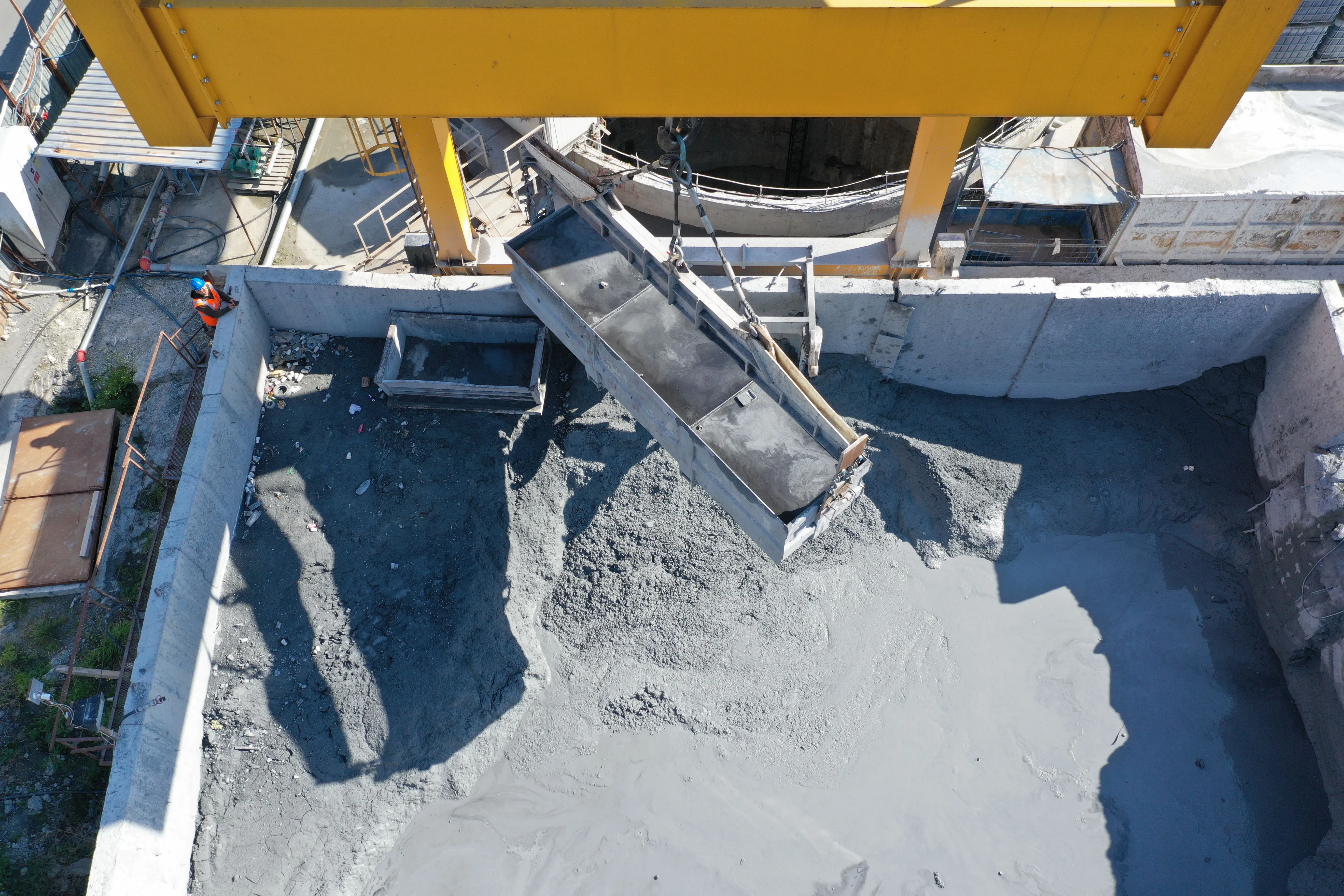
Cement Calcination: Why 60% Can't Be Cut
Key Takeaways
- This guide covers industry guide reporting requirements based on IR (EU) 2025/2621 and EU Regulation 2023/956
- All emission factors and CN codes referenced are verified against the latest EU implementing regulations
- Practical steps and common mistakes are drawn from hands-on implementation experience with the CbamTrack platform
From the team behind CbamTrack
We built this guide based on hands-on experience implementing CBAM compliance for SME importers. The calculations and workflows described here power our own platform — this is not theory, it's what we ship.
Cement and clinker are among the most carbon-intensive CBAM-covered products. This guide covers everything cement importers need for compliant quarterly CBAM reporting.
"Cement emissions come primarily from the calcination process — a chemical reaction converting limestone to clinker, not a fuel-combustion emission." — CBAM Q&A (May 2026)
Why Cement Is Under CBAM
Cement production accounts for roughly 7–8% of global CO₂ emissions, making it the second-largest industrial emitter after steel. The EU imported approximately 12 million tonnes of cement and clinker in 2025, with Turkey, Egypt, and Vietnam as the top suppliers. Under CBAM, every tonne of imported cement must account for its embedded carbon, and the costs are real: at €75/tCO₂e, a single shipment of 20,000 tonnes of clinker carries roughly €1.38 million in CBAM certificate liability.
CN Codes for Cement Products
Cement products fall under HS Chapter 25, primarily within the 2507 and 2523 ranges:
| Product Type | CN Code | Description |
|---|---|---|
| Kaolin | 2507 | Kaolin and other kaolinic clays |
| Clinker | 2523 10 | Cement clinkers |
| White Portland | 2523 21 | White Portland cement |
| Other Portland | 2523 29 | Other Portland cement |
| Aluminous | 2523 30 | Aluminous cement |
| Other hydraulic | 2523 90 | Other hydraulic cements |
Each CN code carries specific default emission factors. Using the wrong code results in incorrect calculations and potential compliance issues. CbamTrack's CN code validator flags mismatches automatically during data entry.
Emission Factors for Cement
Cement production is inherently carbon-intensive due to the calcination process — roughly 60% of emissions come from the chemical reaction itself, not from fuel combustion. This means even plants running on renewable energy still have significant unavoidable process emissions.
| Product | Default Factor (tCO₂e/tonne) | Key Source |
|---|---|---|
| Clinker | 0.92 | Calcination + fuel |
| Portland cement | 0.87 | Clinker dilution |
| White Portland | 0.88 | Selective raw materials |
| Aluminous cement | 0.95 | Higher alumina content |
| Other hydraulic | 0.85 | Varies by formulation |
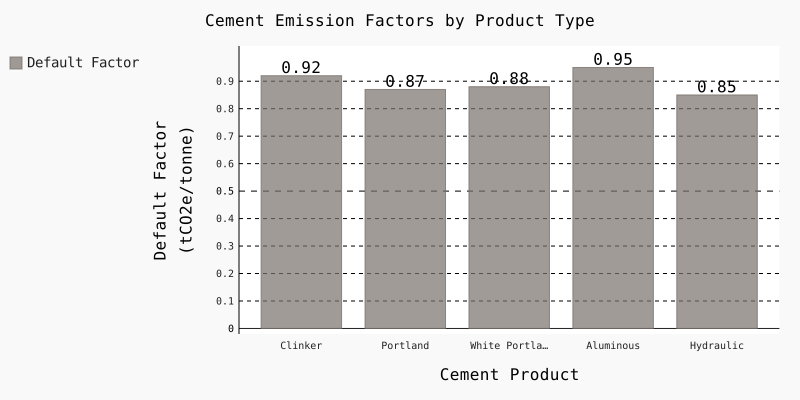
The clinker-to-cement ratio is the primary driver of emission intensity. Higher clinker ratios mean higher embedded emissions. European producers typically operate at 0.65–0.75 clinker-to-cement ratios, while some non-EU producers still operate above 0.85, resulting in substantially higher embedded emissions per tonne.
Country-Specific Factors
Cement emission factors vary by country due to different energy mixes and production efficiencies:
| Country | Direct Factor Range | Notes |
|---|---|---|
| Turkey | 0.61–0.72 | Mixed fuel sources |
| China | 0.82–0.95 | Coal-heavy production |
| India | 0.75–0.88 | Varies by plant |
| Egypt | 0.70–0.82 | Natural gas dominant |
| Vietnam | 0.68–0.80 | Improving efficiency |
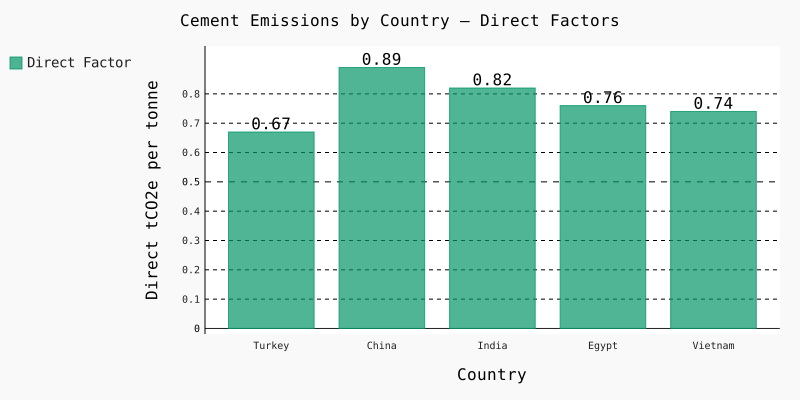
Always use country-specific default factors rather than global averages for accurate reporting.
Data Collection for Cement Imports
Required Data Points
- Specific CN code (not just "cement")
- Quantity imported (tonnes)
- Clinker ratio (if known)
- Country of origin
- Supplier-specific data (if available)
Documentation to Maintain
- Mill certificates with clinker content
- Supplier emission declarations
- Import customs declarations
- Bill of lading
CbamTrack provides pre-configured cement product templates with correct CN codes and emission factors.
Common Cement-Specific Errors
Using generic "cement" — Different cement types (Portland, aluminous, hydraulic) have different CN codes and factors. Always specify the exact product type.
Ignoring clinker ratio — The clinker-to-cement ratio directly affects embedded emissions. If your supplier provides this data, use it for more accurate calculations.
Wrong country factors — Cement production in coal-heavy economies (China, India) has higher emissions than gas-based production (Egypt, parts of Turkey).
FAQ
Do I need to report for cement clinker separately from finished cement? Yes. Clinker (CN 2523 10) and finished cement (CN 2523 29) are different CN codes with different emission factors.
What if I don't know the exact cement type? Use the most specific CN code available. If you only know it's "Portland cement," use 2523 29 rather than the general 2523 code.
Can I use actual emission data instead of defaults? Yes. If your supplier provides verified emission data, you can use actual factors. This typically results in lower reported emissions for efficient producers.
Sources
- EU Regulation 2023/956 — CBAM main regulation
- IR (EU) 2025/2621 — Default emission values and cement benchmarks
- IR (EU) 2025/2548 — CBAM certificate price calculation and publication
- European Commission CBAM page
CbamTrack automates cement CBAM reporting with pre-configured CN codes, country-specific emission factors, and annual declaration generation. Try the free calculator for instant cost estimates, or start free to streamline your cement import compliance.
Important Financial Disclaimer
The financial figures, cost estimates, and compliance scenarios discussed in this article are for informational purposes only. Actual CBAM liability depends on your specific import profile, verified emission data, and regulatory interpretations. Consult a qualified CBAM advisor or customs professional before making compliance decisions.
This article was researched and written with AI assistance. Figures and regulatory references are cross-checked against official EU sources (EUR-Lex, European Commission CBAM page) and updated when the rules change.
R. Emrah Gökkaya
I built CbamTrack because I saw SME exporters struggling with spreadsheets and confusing regulations. Every article here reflects what I've learned implementing IR 2025/2621-compliant calculations, integrating live EU ETS pricing, and building the emission factor database that powers our platform.
View full author bio →Ready to simplify your CBAM compliance?
Subscribe today and generate your first CBAM report in minutes.