Steel CN Codes & CBAM Emission Factors
Key Takeaways
- This guide covers industry guide reporting requirements based on IR (EU) 2025/2621 and EU Regulation 2023/956
- All emission factors and CN codes referenced are verified against the latest EU implementing regulations
- Practical steps and common mistakes are drawn from hands-on implementation experience with the CbamTrack platform
From the team behind CbamTrack
We built this guide based on hands-on experience implementing CBAM compliance for SME importers. The calculations and workflows described here power our own platform — this is not theory, it's what we ship.
Steel and iron products account for the largest volume of CBAM-covered imports. This guide covers everything steel importers need for compliant quarterly reporting.
"Steel sector benchmarks: BF-BOF 1.370 tCO₂e/tonne, DRI-EAF 0.481 tCO₂e/tonne, Scrap-EAF 0.072 tCO₂e/tonne." — IR (EU) 2025/2621, Annex I
All emission factors and CN codes in this article are sourced from IR (EU) 2025/2621 and EU Regulation 2023/956, Annex I. Last verified: July 2026.
Why Steel Matters Most Under CBAM
Steel and iron products represent the largest share of CBAM-covered imports by both volume and value. In 2025, the EU imported over 30 million tonnes of steel products from non-EU countries. The financial exposure is significant: at current ETS prices of approximately €75/tCO₂e, a single 25,000-tonne shipment of BF-BOF steel rebar from China carries roughly €3.4 million in CBAM certificate costs. Getting the reporting right is not optional — it is a direct cost of doing business.
CN Codes for Steel and Iron Products
Steel products fall under CN Chapter 72 (Iron and Steel) and selected codes in Chapter 73 (Articles of Iron or Steel):
| Product Type | CN Code Range | Examples |
|---|---|---|
| Primary products | 7201–7205 | Pig iron, ferro-alloys |
| Semi-finished | 7206–7207 | Ingots, blocks, billets |
| Flat-rolled | 7208–7212 | Sheets, plates, coils |
| Long products | 7213–7216 | Bars, rods, angles |
| Wire | 7217 | Steel wire |
| Tubes and pipes | 7301–7306 | Seamless, welded |
Each CN code has specific default emission factors based on production method and country of origin. The difference between adjacent CN codes can be significant — for example, flat-rolled products (7208) and long products (7214) from the same country can differ by 15–20% in embedded emissions per tonne.
Emission Factors by Production Method
Steel production methods have fundamentally different emission profiles, and factor selection is the single most important calculation step:
| Production Route | Emissions (tCO₂e/tonne) | Market Share | Notes |
|---|---|---|---|
| Blast Furnace (BF-BOF) | 1.5–2.5 | Dominant | Higher default factors |
| Electric Arc Furnace (EAF) | 0.3–0.8 | Growing | Lower default factors |
| Direct Reduced Iron (DRI) | 0.8–1.5 | Specialised | Country-dependent |
Emission ranges are indicative. Actual default factors vary by CN code and country of origin — always verify against IR (EU) 2025/2621.
The production method determines your reporting exposure. A shipment of Turkish rebar produced via EAF has roughly one-third the embedded emissions of the same product from a BF-BOF plant. Knowing your supplier's production route is essential for accurate CBAM reporting.
Country-Specific Factors
Default emission factors vary by country of origin. For example, steel rebar (CN 7214):
| Country | Direct Factor (tCO₂e/t) | Indirect Factor (tCO₂e/t) |
|---|---|---|
| Turkey | 0.535 | 0.137 |
| China | 1.824 | 0.412 |
| India | 1.615 | 0.389 |
| South Korea | 0.723 | 0.184 |
| Japan | 0.698 | 0.176 |
Source: IR (EU) 2025/2621 — Default values for iron and steel sector
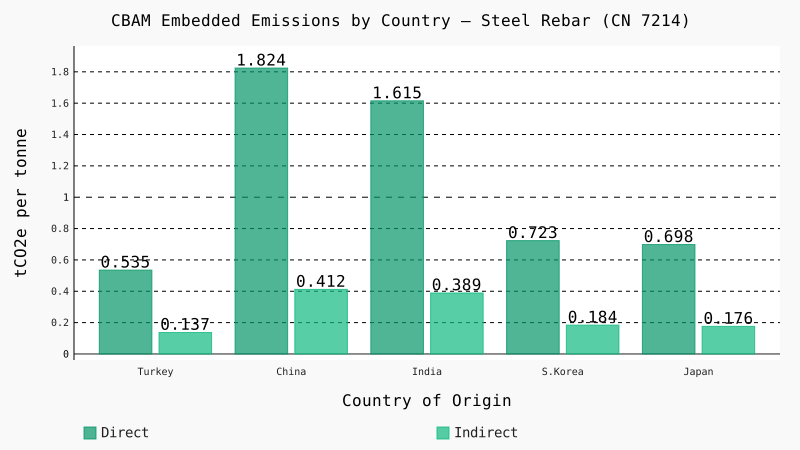
The country-specific variation is dramatic: Chinese steel rebar has over three times the embedded emissions of Turkish rebar. This means country of origin directly impacts your CBAM liability. Always verify that you are using the correct factor for both the product type AND the country of origin.
Data Collection for Steel Products
Required Data Points
- Steel product type (specific CN code)
- Quantity imported (tonnes)
- Production method (BF, EAF, or DRI)
- Country of origin
- Supplier emission data (if using actual factors)
Documentation to Maintain
- Mill test certificates
- Supplier emission declarations
- Bills of lading
- Customs import declarations
CbamTrack includes pre-configured product templates for steel importers to streamline data entry and ensure nothing is missed.
Common Steel-Specific Errors
Mixing CN codes — Flat and long products have different codes and factors. Verify each product type separately.
Ignoring production method — The same product from the same country can have different factors depending on whether it was made in a blast furnace or electric arc furnace.
Wrong country factors — Using generic EU averages instead of country-specific default factors will produce incorrect emission calculations. China-sourced steel at 1.824 tCO₂e/t vs the EU average of 0.8 means you could under-report by more than half.
FAQ
Do I need to report separately for each steel grade? Report at the CN code level. Different grades within the same CN code use the same emission factor.
How do I handle scrap-based steel? Scrap-based (EAF) steel has lower default factors. Ensure the production method is correctly documented.
What about coated or treated steel products? Coated steel products may fall under different CN codes. Verify the correct classification before reporting.
Sources
- EU Regulation 2023/956 — CBAM main regulation
- IR (EU) 2025/2621 — Default emission values and steel benchmarks
- IR (EU) 2025/2620 — Benchmark values for free allocation
- European Commission CBAM page
All emission factors and CN codes in this article are sourced from IR (EU) 2025/2621 and EU Regulation 2023/956, Annex I. Last verified: July 2026.
Streamline Your Steel CBAM Reporting
Steel importers face the most complex CBAM reporting requirements due to multiple production methods and country-specific factors. CbamTrack handles CN code mapping, factor selection, and emission calculation automatically. Try the free calculator to estimate your steel CBAM costs, or see how we compare against ClimEase and Dubrink for steel reporting.
This article was researched and written with AI assistance. Figures and regulatory references are cross-checked against official EU sources (EUR-Lex, European Commission CBAM page) and updated when the rules change.
R. Emrah Gökkaya
I built CbamTrack because I saw SME exporters struggling with spreadsheets and confusing regulations. Every article here reflects what I've learned implementing IR 2025/2621-compliant calculations, integrating live EU ETS pricing, and building the emission factor database that powers our platform.
View full author bio →Ready to simplify your CBAM compliance?
Subscribe today and generate your first CBAM report in minutes.