UK CBAM 2027: What Importers Need to Know
Key Takeaways
- This guide covers guide reporting requirements based on IR (EU) 2025/2621 and EU Regulation 2023/956
- All emission factors and CN codes referenced are verified against the latest EU implementing regulations
- Practical steps and common mistakes are drawn from hands-on implementation experience with the CbamTrack platform
From the team behind CbamTrack
We built this guide based on hands-on experience implementing CBAM compliance for SME importers. The calculations and workflows described here power our own platform — this is not theory, it's what we ship.
UK CBAM: the basics
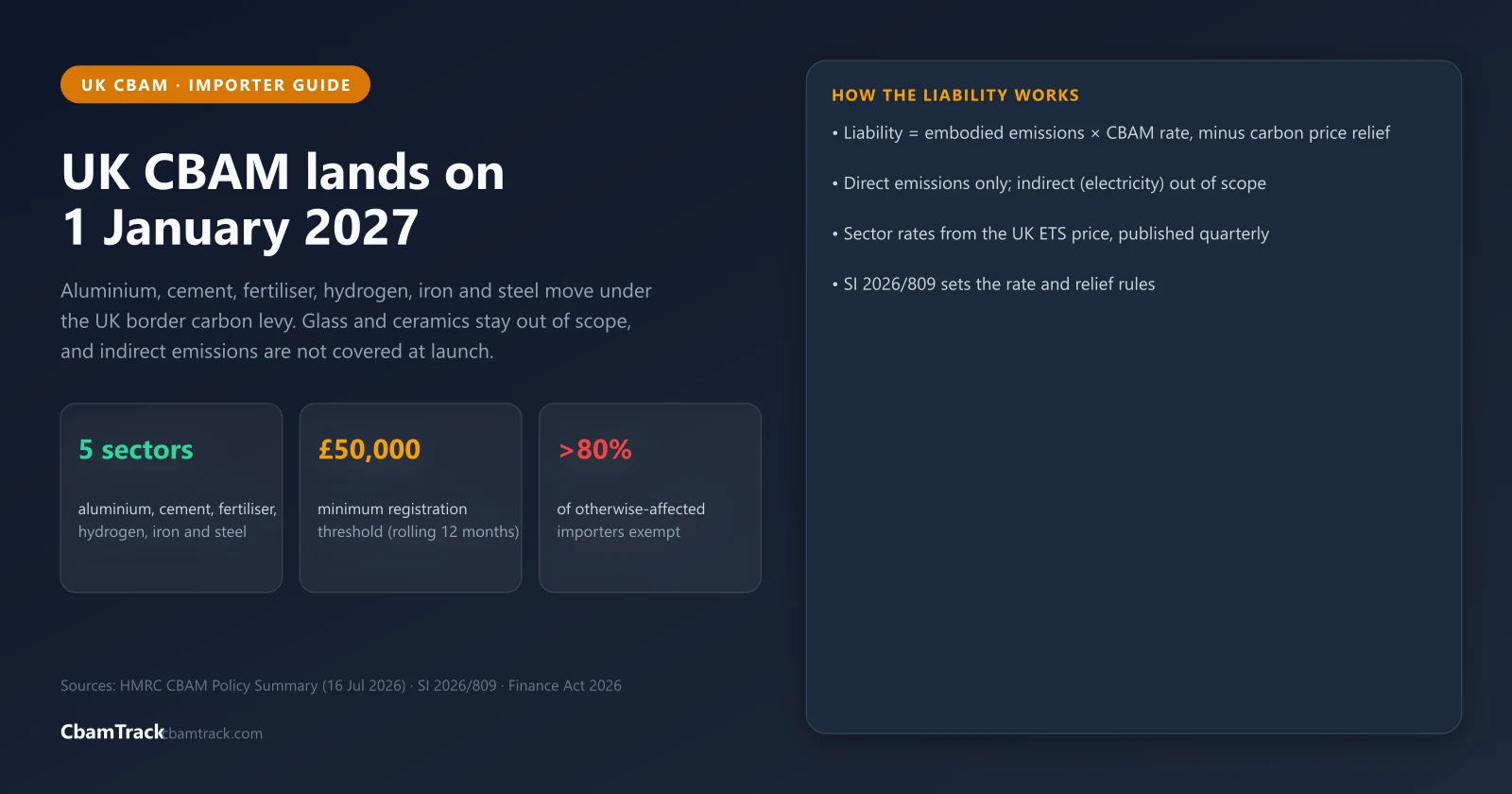
The UK is launching its own carbon border adjustment mechanism on 1 January 2027, a year after the EU's definitive regime. The policy summary published by HMRC (updated 16 July 2026) sets out the full picture.
"CBAM will commence on 1 January 2027." HMRC, Carbon border adjustment mechanism (CBAM): Policy Summary (updated 16 July 2026)
The mechanism is being set up through two layers of legislation. The primary legislation is the Finance Act 2026 (ukpga/2026/11). The secondary legislation went through two consultation rounds, February to March 2026 and April to May 2026, and the final rules are to be laid later in 2026.
Scope: which goods are covered
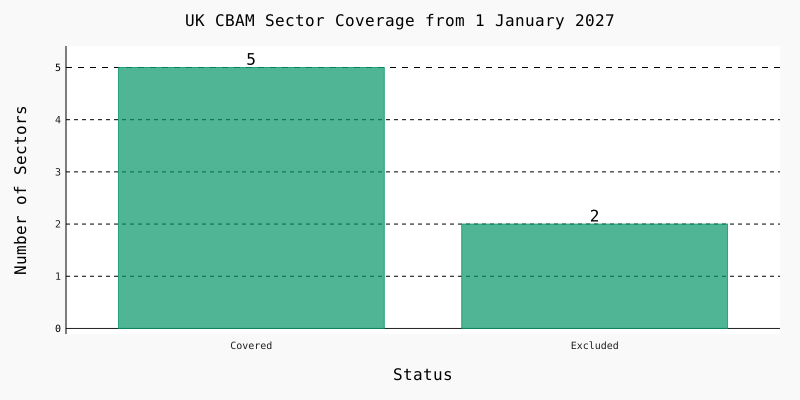
| Sector | Covered from 1 Jan 2027 |
|---|---|
| Aluminium | Yes |
| Cement | Yes |
| Fertiliser | Yes |
| Hydrogen | Yes |
| Iron and steel | Yes |
| Glass | No (excluded) |
| Ceramics | No (excluded) |
A few scope rules matter up front. The mechanism applies to direct emissions, plus relevant precursor goods for complex goods. Indirect emissions (from electricity generation) are not in scope at launch; the government has said their inclusion is delayed until 2029 at the earliest. Coverage is determined by specific 8-digit commodity codes, with scrap excluded for aluminium and iron and steel. It applies across the whole UK, including Northern Ireland, the Crown Dependencies, the Overseas Territories, and the UK Continental Shelf.
Registration threshold: £50,000
A minimum registration threshold applies, based on the total value of CBAM goods imported over a rolling 12-month period:
| Threshold | Effect |
|---|---|
| £50,000 or more | Must register with HMRC, submit returns, pay CBAM |
| Below £50,000 | No registration, no returns, no payment |
"There will be a £50,000 minimum registration threshold when applying the CBAM liability tests." HMRC, CBAM Policy Summary (2026)
HMRC estimates this threshold removes over 80% of otherwise-affected importers (predominantly SMEs) from direct registration while capturing the vast majority of the carbon leakage risk.
Calculating CBAM liability
The formula:
CBAM liability = (embodied emissions × CBAM rate) − carbon price relief (CPR)
Liability is computed as embodied emissions times the CBAM rate, minus any carbon price relief. The CBAM rate is a single rate per sector, not one uniform price. It is calculated from the average UK ETS allowance auction clearing price in the preceding quarter, reduced by a free-allocation adjustment that reflects the sector's historical free allowance coverage and phases out over time. Rates are published quarterly by the government ahead of each operational quarter and are set out in SI 2026/809 (Calculation of CBAM Rate and Determination of Carbon Price Relief).
Emissions are determined one of two ways: actual verified emissions, supported by independent verification reports compliant with international accreditation, or default emissions values published by the government for each good. From 1 January 2027 there is a single default value per good.
Carbon Price Relief is claimable if the goods already paid a qualifying carbon price abroad. It requires verification documentation and calculation records.
Timing and accounting
| Event | Date |
|---|---|
| UK CBAM commences | 1 January 2027 |
| Monitoring period for 2027 imports | January-December 2027 |
| First returns/payments | 31 May 2028 (5 months after year-end) |
| Quarterly rate publication | Ahead of each quarter |
Liability arises when a CBAM good passes the tax point. Goods processed in the UK before the tax point, or re-exported as non-CBAM goods, may attract no liability. For processing scenarios, only the difference in value applies.
UK vs EU CBAM: key differences
| Feature | EU CBAM (2026) | UK CBAM (2027) |
|---|---|---|
| Start date | 1 January 2026 | 1 January 2027 |
| Sectors | Steel, aluminium, cement, fertilisers, hydrogen, electricity | Steel, aluminium, cement, fertilisers, hydrogen (no electricity) |
| Indirect emissions | Reported; not charged for Annex II sectors | Not in scope at launch; expected from 2029 at the earliest |
| Price basis | EU ETS auction average (quarterly 2026, weekly from February 2027) | UK ETS auction average (quarterly) |
| Registration threshold | 50 tonnes/year | £50,000 value threshold |
| Importers exempted | ~90% of importers (de minimis) | >80% of importers |
If you trade with both markets, note that the two mechanisms are separate. Relief from one does not automatically transfer to the other, although the UK is negotiating with the EU on ETS linking, which could eventually exempt both sides from CBAM.
The short version
- UK CBAM starts 1 January 2027, one year after the EU's
- It covers 5 sectors: aluminium, cement, fertiliser, hydrogen, iron and steel (no glass or ceramics)
- A £50,000 registration threshold exempts over 80% of importers
- Direct emissions only at launch; indirect emissions are out of scope
- Sector rates are based on the UK ETS price and published quarterly
Related: How CBAM Affects Your Exports | CBAM Reporting Deadlines | What Is CBAM?
Frequently asked questions
Does UK CBAM apply to indirect emissions?
No. At launch, only direct emissions (plus relevant precursors) are in scope. Indirect emissions are excluded, in line with support for the Energy Intensive Industries Compensation Scheme. The government has said indirect emissions could enter scope from 2029 at the earliest.
What's the CBAM rate in pounds?
Rates are sector-specific and published quarterly, derived from the average UK ETS auction price minus a free-allocation adjustment. The first rates will be published before January 2027.
Can I claim relief for carbon price paid abroad?
Yes. Carbon Price Relief reduces your liability if the goods already paid a qualifying carbon price in their country of origin, subject to verification documentation.
Is there a de minimis like the EU's 50-tonne rule?
The UK uses a £50,000 value-based threshold instead of the EU's mass-based 50-tonne de minimis.
Regulation status
| Field | Value |
|---|---|
| Last reviewed | 2026-08-13 |
| Based on | UK Finance Act 2026, SI 2026/809, HMRC CBAM Policy Summary (16 July 2026) |
| Applies to | UK CBAM from 1 January 2027 |
References
- HMRC, Carbon border adjustment mechanism (CBAM): Policy Summary
- UK Finance Act 2026
- UK Parliament, CBAM legislation
- EU Regulation 2023/956 (for comparison)
Last updated: August 2026 | Sources: HMRC CBAM Policy Summary (16.07.2026), Finance Act 2026, SI 2026/809
This article was researched and written with AI assistance. Figures and regulatory references are cross-checked against official UK sources (HMRC, legislation.gov.uk) and updated when the rules change.
R. Emrah Gökkaya
I built CbamTrack because I saw SME exporters struggling with spreadsheets and confusing regulations. Every article here reflects what I've learned implementing IR 2025/2621-compliant calculations, integrating live EU ETS pricing, and building the emission factor database that powers our platform.
View full author bio →Ready to simplify your CBAM compliance?
Subscribe today and generate your first CBAM report in minutes.