Paid Carbon Price Abroad? It Cuts Your CBAM Certificates Proportionally
Key Takeaways
- This guide covers a legislative proposal that is not yet adopted. The Council agreed its general approach on 12 June 2026 and Parliament adopted its position on 15 September 2026; negotiations are still ongoing
- Every quotation and citation is checked against the primary Council and Parliament documents, not summaries or press coverage
- Practical steps and common mistakes are drawn from hands-on implementation experience with the CbamTrack platform
From the team behind CbamTrack
We track this file from the primary Council and Parliament documents and describe only what the texts actually say. Where a rule is not yet in force, we say so in the text itself.
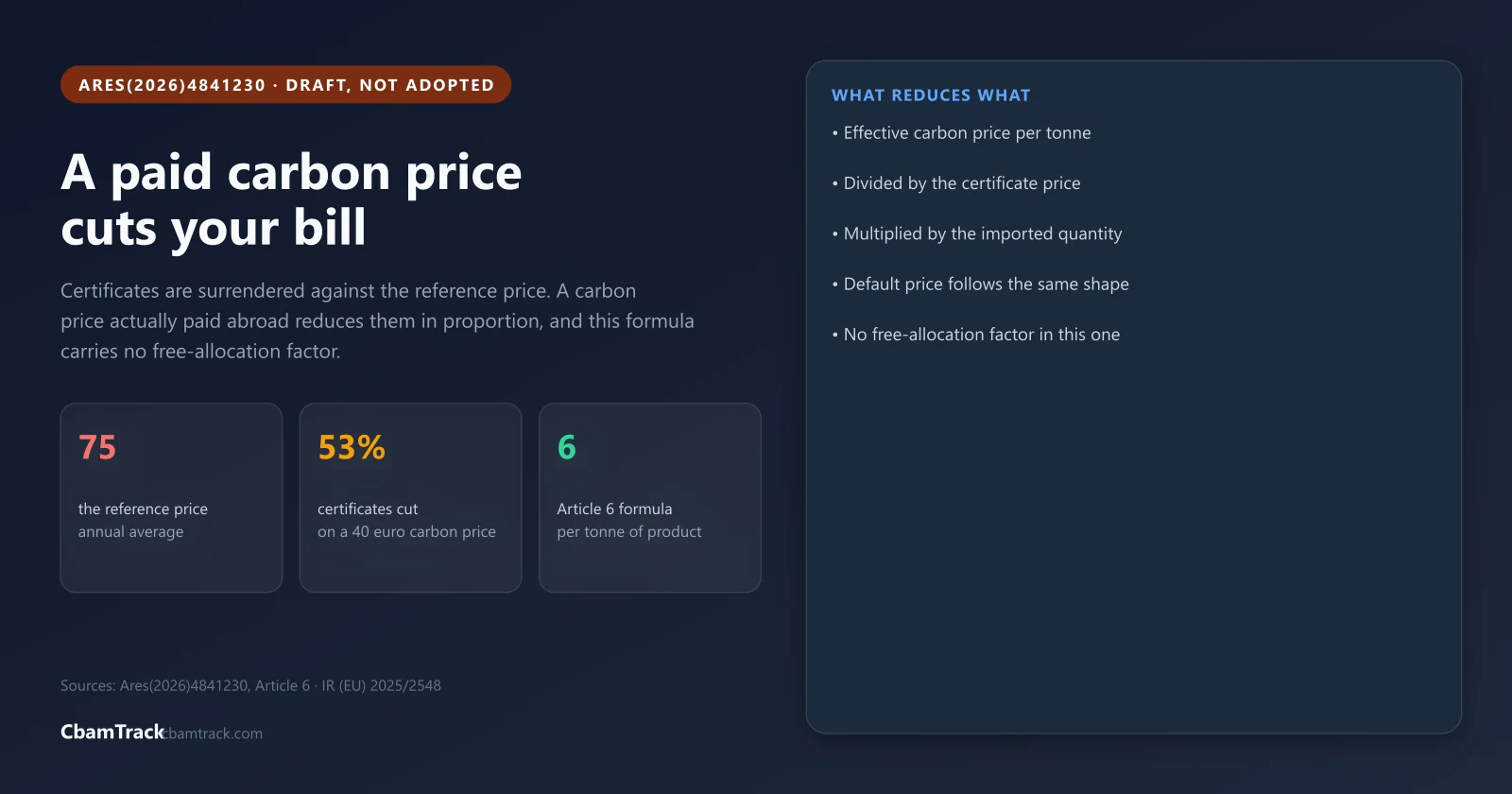
If your government charges €40 per tonne of CO2 and the EU certificate price is €75, do you get €40 off your CBAM bill? No. You get a reduction of roughly 53 per cent, and only because the mechanism divides one number by the other instead of subtracting.
That distinction is the whole point of the draft regulation now sitting on the Commission desk, and it is more counter-intuitive than the headline suggests.
The document is a draft Commission implementing regulation, reference Ares(2026)4841230, dated 13 May 2026, covering "the conversion of the carbon price paid in a third country into a corresponding reduction in the number of CBAM certificates to be surrendered". It carries a warning on its first page:
"This draft has not been adopted or endorsed by the European Commission. Any views expressed are the preliminary views of the Commission services and may not in any circumstances be regarded as stating an official position of the Commission."
Draft Commission Implementing Regulation, Ares(2026)4841230, page 1
None of it is in force yet. The mechanics are specific enough to plan against, and they apply to emissions released from 1 January 2026.
The formula, exactly as drafted
Two formulas sit in the text, because the treatment differs depending on whether you reported actual values or defaults.
Where you reported actual emissions and a carbon price was effectively paid:
ReductionActualCarbonPrice(g) = (€EFF_CP(g) / Ref Price CBAM) × Q(g)
Draft Commission Implementing Regulation, Article 6(1)
Where €EFF_CP(g) is "the effective carbon price, expressed in EUR per tonne of good or per MWh, as included in the certification report pursuant to Article 17", Ref Price CBAM is "the yearly reference price of CBAM certificates, expressed in EUR per tonne of CO2e for the year of import", and Q(g) is the declared quantity in tonnes or MWh.
Where you reported a default value but a default carbon price applies:
ReductionDefaultCarbonPrice(g) = (€DCP × SEE(g) / Ref Price CBAM) × Q(g)
Draft Commission Implementing Regulation, Article 6(2)
Here €DCP is the yearly default carbon price made available under Article 9(5) of the CBAM Regulation, and SEE(g) is the declared embedded emissions of the good, "corresponding either to the actual specific embedded emissions or to the default value used for the good".
The consequences do not all point in the same direction.
Start with the division. Whatever share of the CBAM price your home carbon price covers is the share of your certificate liability deemed satisfied, and there is no subtraction anywhere in the formula. A €40 carbon price against a €75 reference price gets you roughly 53 per cent, not €40.
Your reference price is fixed and public. The Commission calculates it as "the average of the price of CBAM certificates published pursuant to Implementing Regulation (EU) 2025/2548", and that average "shall be rounded to the nearest cent". One number for the whole year, published once. It does not move with your import date.
Then there is the unit. €EFF_CP(g) is already attributed to the good, so a plant with a high carbon price but very clean production ends up with a low figure per tonne of product, and the reduction is modest as a result. Emission intensity cuts both ways. People who assume a high domestic carbon price is always a big win tend to miss that.
"Effectively paid" is doing heavy lifting
The formula rewards the carbon price you can demonstrate you actually bore, net of everything you got back. Article 8 sets out what must be identified and deducted when the operator prepares the carbon price report:
"(a) a reduced tax rate under a carbon tax, levy or fee; (b) any exemption of the emissions coverage in the carbon price mechanism, including: (i) emissions associated with free allowances received by the operator; (ii) emissions that are below an emission intensity baseline under a baseline-and-credit emissions trading system; and (iii) emissions exempted from the application of the carbon tax, levy or fee; (c) a refund in monetary value that partially or totally compensates the carbon price paid, including forms of indirect cost compensation due to a carbon price mechanism; (d) any other rebate or form of compensation that is based on any relevant parameters establishing the effective carbon price to be paid on the emissions covered by a carbon price mechanism."
Draft Commission Implementing Regulation, Article 8(1)
Four categories, and each one can hollow out your claimed price. A headline carbon tax rate is not your effective carbon price. (Ask your finance team for the net figure, not the one from the press release.) In practice the deductions look like this:
- A reduced tax rate under a carbon tax, levy or fee.
- Any exemption from emissions coverage, which includes free allowances, emissions below an intensity baseline in a baseline-and-credit system, and emissions carved out of the tax, levy or fee.
- A refund or indirect cost compensation that puts money back against the price you paid.
- Any other rebate or compensation tied to the parameters that set the effective price.
The sharpest case is (b)(ii). In a baseline-and-credit trading system, an installation below its intensity baseline receives free credits and pays nothing for the difference, so those emissions are excluded from coverage and the effective price on them is zero. The draft defines that system explicitly as "the form of emission trading system where a baseline is established as an emission limit under which no carbon price is due and tradable emission credits are issued to entities that emit less than the baseline". If your country runs that kind of scheme, your effective price is far below your headline price.
Free allowances have the same effect under (b)(i), which links this back to the ETS phase-out. An EU producer's free allocation reduces its effective carbon price. A non-EU producer with a national ETS handing out free allowances gets the same reduction in claimed benefit, whether or not the EU producer would call that fair.
There is a derogation, and it is narrow. Where the installation "benefits from subsidies financed by the revenues generated by the carbon price mechanism", the valuation of those subsidies is treated differently. Recycling carbon revenue into subsidies doesn't simply disappear from the calculation, but it is handled under its own rule in Article 8(2) rather than being ignored.
What counts as a carbon price mechanism
The definition is broader than "tax":
"'carbon price mechanism' means carbon tax, carbon fee or carbon levy, or an emissions trading system"
Draft Commission Implementing Regulation, Article 2(3)
So a cap-and-trade system qualifies, and so does a fee. Recital (8) explains the intent: equivalence is drawn only for "carbon prices paid on specific embedded emissions", so a price that does not attach to the emissions in your product cannot be claimed against them.
You will need a certified carbon price report, not a tax return
This is the operational change most likely to surprise exporters. Article 7 requires a dedicated document:
"The operator shall draw up an operator's carbon price report on the basis of the methodology set out in Annex I, using the electronic template made available by the Commission via the CBAM registry and containing at least the information set out in Annex II. ... The operator shall draw up the operator's carbon price report in English."
Draft Commission Implementing Regulation, Article 7(1) and (3)
An audited financial statement or a tax assessment is not the artefact. The report is prepared on a Commission template, in English, and transmitted to an independent person through the CBAM registry where the operator is registered.
The reporting period is aligned with your emissions verification cycle, not with the tax year. It "shall be the same as the reporting period referred to in the verification report pursuant to Article 6 of Implementing Regulation (EU) 2025/2546".
Where emissions sit under more than one mechanism, the prices are aggregated per good:
"Where the embedded emissions are subject to different carbon price mechanisms, the carbon prices effectively paid under those mechanisms shall be aggregated for each good produced by the installation in accordance with point 7.1 of Annex I."
Draft Commission Implementing Regulation, Article 3(4)
Precursors and indirect emissions have their own default route
Article 4 lets you avoid chasing carbon price documentation for emissions you did not produce:
"For the purposes of determining the carbon price effectively paid for the embedded emissions of a precursor produced outside the installation, the operator may, in accordance with point 6.2 of Annex I, use the relevant default carbon price made available by the Commission pursuant to Article 9(5) of Regulation (EU) 2023/956."
Draft Commission Implementing Regulation, Article 4(1)
The same applies to indirect emissions of a good not listed in Annex II to the CBAM Regulation. Practically, this is the escape valve for the hardest part of the indirect emissions calculation: you can take a default carbon price rather than reconstruct your supplier's electricity pricing. Whether you should is a separate decision, because it substitutes a default for a real number.
Currency conversion is fixed for the year too
"The operator shall, in accordance with point 7.1 of Annex I, convert into euro the carbon price effectively paid for each good produced by the installation, using the yearly average exchange rate for the year of the reporting period ... the Commission shall publish the yearly average exchange rates, using the exchange rates published by the European Central Bank or, where appropriate, by Eurostat."
Draft Commission Implementing Regulation, Article 5(1) and (3)
One annual average per currency, published by the Commission. Recital (18) justifies it: the aim is "a consistent and objective conversion into euro of carbon prices paid in foreign currencies for a given reporting period". You're not exposed to intra-year currency moves, or to your own treasury's choice of rate. If no average exists for a currency, "the Commission shall use the most reliable and publicly available information".
Certification is a real assurance engagement, and there is a materiality threshold
The independent person doesn't tick a box. It works to a defined standard of assurance, and it can go below your materiality level.
"'reasonable assurance' means a high, but not absolute, level of assurance expressed positively in the certification opinion, as to whether the operator's carbon price report is free from material misstatement"
Draft Commission Implementing Regulation, Article 2(6)
"The independent person may consider misstatements as material even if they, individually or when aggregated with other misstatements, are below the materiality level laid down in Article 16, where such consideration is justified by the size and nature of the misstatements and the particular circumstances of their occurrence."
Draft Commission Implementing Regulation, Article 15(4)
That last clause is the one to note. A small error isn't automatically immaterial. If you have a specific argument that a discrepancy is immaterial, expect to make it explicitly.
The checks run deep into the emissions trading system. Where the carbon price data rests on an ETS, the independent person checks consistency between your reported emissions and "evidence of corresponding emissions allowances or credits surrendered", and if allowances were allocated for free, "consistency of the quantity of those allowances allocated for free and regulatory decisions in which those allowances were issued to the operator". That last check reaches into your regulator's paperwork, not just your own.
Where problems are found, there is a process. The independent person informs you "without delay", you correct, and it documents and marks each correction as resolved. If you don't correct, it must ask you to explain the cause and your reasons before the report is issued, then assess materiality.
The verifier commits to next year by 15 November
"By 15 November of each year, independent persons shall submit to the national accreditation body that has accredited them the following information for the next calendar year: (a) the planned time and place of the certifications they are to carry out, indicating whether a physical or virtual site visit will be conducted; (b) the name and identification details of each operator whose carbon price reports are subject to their certification, and the identification details of the installations concerned; (c) the names of the members of the certification team and the scope of the accreditation covering the operator's activities."
Draft Commission Implementing Regulation, Article 31(1)
That is a forward commitment, not a retrospective one. You will know in advance which months a verifier is on site and who is on the team, which means your data has to exist before then.
None of this is law, and it is retroactive if adopted
Two cautions, and they do not depend on each other.
The draft has not been adopted. The text says so on its own first page. Every figure, threshold and procedure above is a proposal from Commission services.
The application date runs backwards from the draft's own issue date. Recital (38) ties it to "the yearly average carbon price effectively paid on greenhouse gas emissions released from 1 January 2026", and Article 32 states that the regulation "shall enter into force on the third day following that of its publication in the Official Journal of the European Union" and "shall apply from 1 January 2026". A regulation published in late 2026 would reach back to emissions released throughout 2026.
What you can do now is inventory. For every product line:
- Identify the carbon price mechanisms that apply.
- Calculate the effective price net of every rebate and exemption listed in Article 8(1).
- Compare that figure against the yearly reference price.
If the ratio is small, you have learned something worth knowing before you commission any verification work. If it is large, you now know where to focus your data collection.
Frequently asked questions
Does a carbon price paid abroad reduce my CBAM bill by the same amount?
No. The draft reduces certificates proportionally: the effective carbon price embedded in your good is divided by the yearly CBAM certificate reference price. A €40 carbon price against a €75 reference price reduces the liability by roughly 53 per cent, not by €40.
What is the yearly reference price?
It is the average of CBAM certificate prices published under Implementing Regulation (EU) 2025/2548 for the year of import, rounded to the nearest cent. One figure per year, calculated by the Commission, not per shipment.
What counts as a carbon price mechanism?
Carbon tax, carbon fee, carbon levy, or an emissions trading system. The price must attach to the specific embedded emissions, not to something else in your cost base.
Are free allowances deducted from my effective carbon price?
Yes. Emissions associated with free allowances are treated as exempt from emissions coverage, and Article 8(1)(b)(i) requires the operator to identify and account for them. The same logic applies to emissions below the baseline in a baseline-and-credit system.
Do I need a carbon price report?
Yes, under the draft. Article 7 requires an operator's carbon price report on the Commission's electronic template, prepared in English and passed to the independent person, generally through the CBAM registry.
Can I avoid chasing carbon price evidence for my suppliers' precursors?
Article 4 allows you to use the relevant default carbon price published by the Commission for precursor emissions produced outside your installation, and for indirect emissions of a good not listed in Annex II to the CBAM Regulation.
How is a foreign currency carbon price converted?
Using the yearly average exchange rate for the year of your reporting period, published by the Commission from European Central Bank or, where appropriate, Eurostat rates.
When does this start applying?
It doesn't yet. The draft has not been adopted. If adopted as drafted, Article 32 applies it from 1 January 2026, reaching back to emissions released during 2026.
Regulation status
| Field | Value |
|---|---|
| Last reviewed | 2026-10-03 |
| Based on | Draft Commission Implementing Regulation, Ares(2026)4841230 of 13 May 2026, Articles 2, 3, 4, 5, 6, 7, 8, 15, 16, 17, 31, 32 and recitals (8), (18), (38) |
| Legal status | Draft. Explicitly not adopted and not endorsed by the Commission. |
References
- Regulation (EU) 2023/956, the CBAM Regulation, EUR-Lex
- IR (EU) 2025/2546, verification of declared embedded emissions, EUR-Lex
- IR (EU) 2025/2547, CBAM methodology, EUR-Lex
- IR (EU) 2025/2548, CBAM certificate price, EUR-Lex
- European Commission, CBAM legislation and guidance
- Indirect emissions rules by sector
- CBAM certificate cost calculation
- How to calculate embedded emissions
Draft Commission Implementing Regulation Ares(2026)4841230 was consulted as a local copy (33 pages). The document carries no adopted regulation number; it is a Commission services draft and must not be cited as enacted law.
Last updated: October 2026 | Sources: Draft Commission Implementing Regulation Ares(2026)4841230 (13 May 2026)
Important Financial Disclaimer
The financial figures, cost estimates, and compliance scenarios discussed in this article are for informational purposes only. Actual CBAM liability depends on your specific import profile, verified emission data, and regulatory interpretations. Consult a qualified CBAM advisor or customs professional before making compliance decisions.
This article was researched and written with AI assistance. Figures, quotations and legislative status are cross-checked against primary EU sources (Council documents, European Parliament press releases, EUR-Lex). This file is not adopted yet; the article states the current negotiating status explicitly.
R. Emrah Gökkaya
I built CbamTrack because I saw SME exporters struggling with spreadsheets and confusing regulations. Every article here reflects what I've learned implementing IR 2025/2621-compliant calculations, integrating live EU ETS pricing, and building the emission factor database that powers our platform.
View full author bio →Ready to simplify your CBAM compliance?
Subscribe today and generate your first CBAM report in minutes.