CBAM Mid-Year 2026 Update: Price & Expansion
Key Takeaways
- This guide covers guide reporting requirements based on IR (EU) 2025/2621 and EU Regulation 2023/956
- All emission factors and CN codes referenced are verified against the latest EU implementing regulations
- Practical steps and common mistakes are drawn from hands-on implementation experience with the CbamTrack platform
From the team behind CbamTrack
We built this guide based on hands-on experience implementing CBAM compliance for SME importers. The calculations and workflows described here power our own platform — this is not theory, it's what we ship.
The first half of 2026: a lot happened
The definitive phase of CBAM began on 1 January 2026, and the first six months have already produced a steady run of operational and legislative changes. This update pulls together the items worth your attention: the Q2 certificate price, how buying and reselling certificates will work, where verifier accreditation stands, and where the expansion regulation sits in the legislative process.
"On 6 July 2026, the European Commission published the CBAM Certificate price for Q2 2026 which is now EUR 75,28." Van Bael & Bellis, Client Alert, 20 July 2026
Certificate prices in 2026
Certificate prices are set quarterly, based on the average EU ETS auction price.
| Quarter | Price (€/tCO₂) | Published |
|---|---|---|
| Q1 2026 | €75.36 | 7 April 2026 |
| Q2 2026 | €75.28 | 6 July 2026 |
| Q3 2026 | To be published | 5 October 2026 |
| Q4 2026 | To be published | 4 January 2027 |
From 2027, prices move to a weekly calculation basis.
These numbers matter because every tonne of embedded CO₂ in your imports is priced near €75 today. In 2026 the CBAM factor is still just 2.5%, so the free allocation deduction covers 97.5% of the benchmark. That cover shrinks in stages, and prices start moving weekly next year. Planning purchases now, or at least setting supplier data collection targets, protects you against both price swings and the steep phase-in that follows.
Selling and repurchasing certificates
On 9 July 2026 the Commission opened a public consultation, open until 6 August 2026, on a draft delegated regulation that sets out how CBAM certificates can be sold and repurchased:
- The CBAM registry will be the main point of interaction for declarants
- A fee of €0.05 per certificate sold will fund the service
- Repurchase of excess certificates becomes possible from 31 October 2027
There is a catch for declarants who over-purchase in 2027 for 2026 imports. Certificates bought in 2027 for 2026 emissions may only be repurchased in 2027 (Regulation 2023/956, Article 24). If you manage quarterly balances, watch the consultation outcome closely.
Verifier accreditation: the bottleneck everyone saw coming
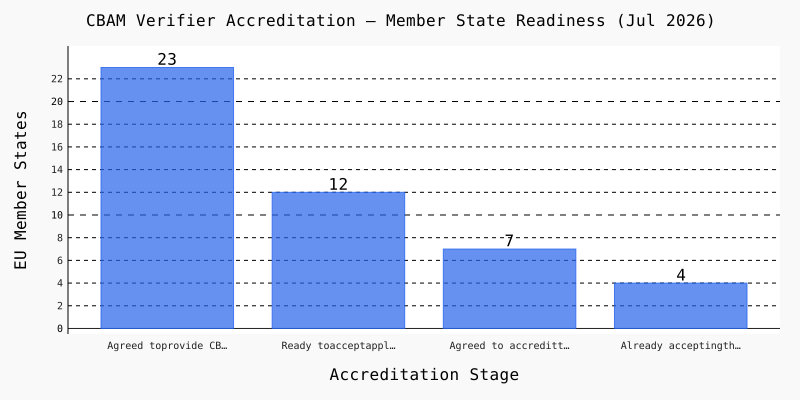
The Commission published an accreditation state of play on 8 July 2026:
| Status | Member States |
|---|---|
| Agreed to provide CBAM accreditation | All except Cyprus, Estonia, Ireland, Malta |
| Ready to accept accreditation applications | Only about half of the above |
| Agreed to accredit third-country verifiers | France, Greece, Italy, Netherlands, Poland, Slovakia, Sweden |
| Already accepting third-country applications | Italy, Netherlands, Poland, Sweden |
"The Netherlands has an agreement with Turkey's accreditation agency, TÜRKAK, and Sweden has an agreement with the National Accreditation Agency of Ukraine (NAAU)." Van Bael & Bellis, Client Alert, 20 July 2026
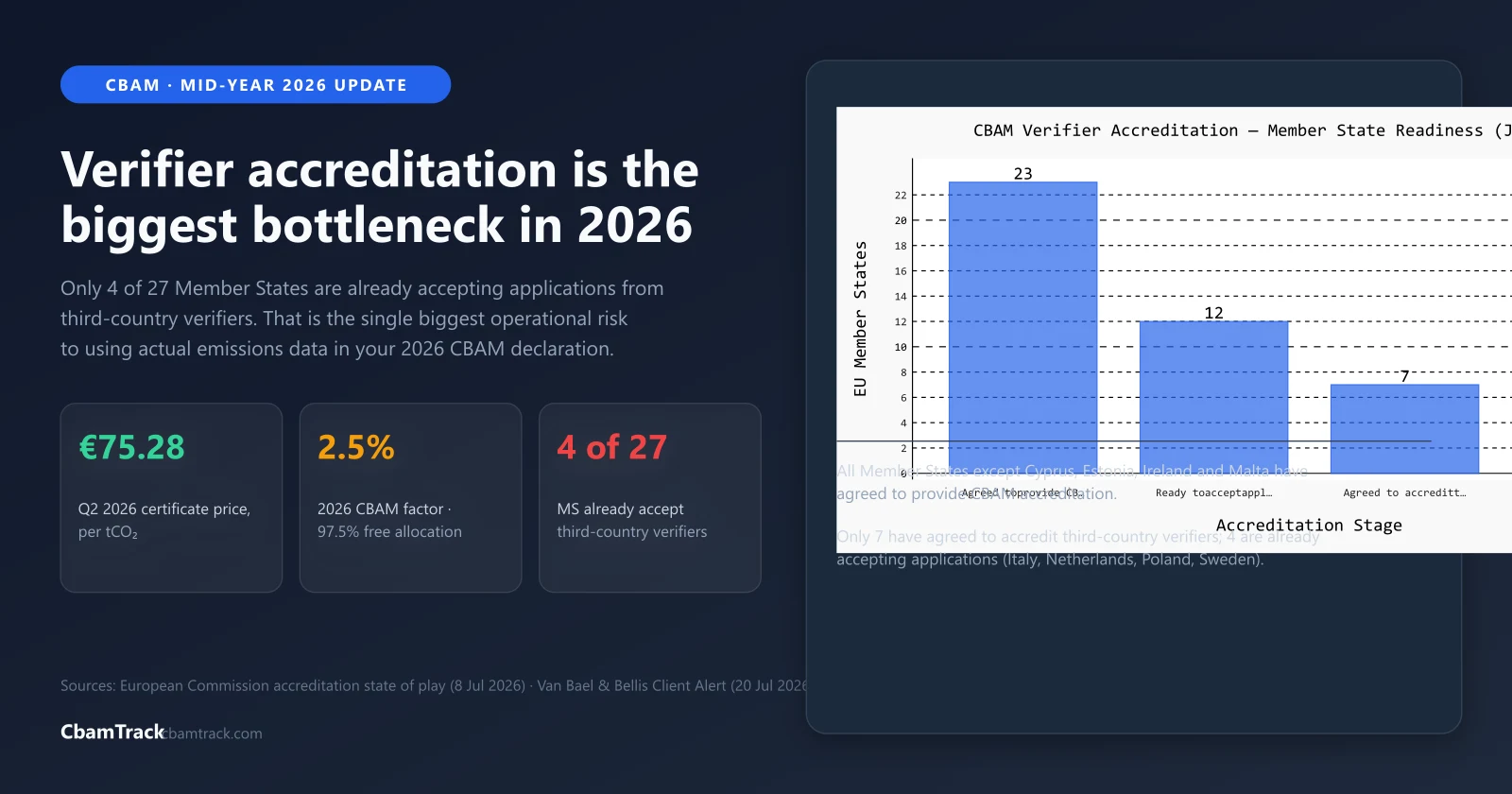
If you plan to use actual emissions data in your 2026 declaration rather than default values, your suppliers' installations must be verified by an accredited verifier. Verification must be completed before the first annual declaration deadline of 30 September 2027, which makes the accreditation bottleneck the single biggest operational risk to using real data this cycle. If your suppliers are not already lined up with a verifier, start now.
Corrected default values are coming
The Commission is working on correcting some of the current default values, with amended values expected soon and a full revision expected in 2027. High default values, especially for countries like China and Indonesia, have drawn steady complaints from industry. We cover the detail in a separate post on CBAM default values.
The expansion regulation: where it stands
The draft regulation extending CBAM to downstream goods and adding anti-circumvention measures is moving through the legislative process:
| Stage | Date | Position |
|---|---|---|
| Commission proposal (COM(2025)989) | 17 December 2025 | ~180 downstream steel and aluminium-intensive products |
| Council general approach | 12 June 2026 | Wider product list, annual review from Jan 2028, 1-year exemptions |
| ENVI committee report | 6 July 2026 | Even wider scope (medical needles, syringes); removes international carbon credits; redirects revenue |
| Plenary vote | 14 to 17 September 2026 | Sets Parliament's negotiating mandate |
| Trilogue | After September plenary | Target: agreement before end of 2026 |
The institutions disagree on a few points:
| Issue | Commission | Council | ENVI Committee |
|---|---|---|---|
| Downstream goods | ~180 products | Similar plus annual review | Broadest scope (incl. medical instruments) |
| Exemptions | Delegated acts for severe harm | Tighter, max 1 calendar year | Removes new exemption; redirects revenue instead |
| Anti-circumvention | "Abusive practices" powers | "Harmful resource shuffling" implementing act | Cross-country default value application; narrowed supply-chain adjustment definition |
| International carbon credits (Art. 6 Paris) | Regulated deduction allowed | Removed | Removed (premature) |
If you import steel or aluminium downstream products such as fasteners, wire, structural components, or vehicle parts, check whether your CN codes appear on any of the three institutional lists. The final scope will likely be significantly wider than the original proposal. Entry into application is targeted for 1 January 2028, and the trilogue outcome should be known by early 2027.
The short version
- The Q2 2026 certificate price is €75.28/tCO₂, near the Q1 level of €75.36
- Sale and repurchase rules are in consultation until 6 August 2026, with a fee of €0.05 per certificate
- Verifier accreditation is the bottleneck: only 4 Member States accept third-country verifier applications today
- Corrected default values are imminent; a full revision lands in 2027
- The expansion regulation reaches trilogue after September 2026, and the downstream scope will grow
Related: CBAM Certificate Cost Formula | How CBAM Affects Your Exports | CBAM Reporting Deadlines 2026
Frequently asked questions
When does the price become weekly?
From 2027. In 2026, prices are published quarterly: Q1 in April, Q2 in July, Q3 in October, Q4 in January.
Can I resell excess CBAM certificates?
Yes. Repurchase requests must be submitted by 31 October of each year, and repurchase happens at the original purchase price, with limitations for 2027 certificates bought for 2026 emissions.
When will the expanded CBAM scope apply?
Targeted for 1 January 2028 for downstream goods, subject to the trilogue outcome expected by the end of 2026.
Regulation status
| Field | Value |
|---|---|
| Last reviewed | 2026-08-01 |
| Based on | Regulation (EU) 2023/956, COM(2025)989, draft delegated regulation on certificate sale/repurchase |
| Applies to | CBAM permanent phase (2026+) |
References
- European Commission, price of CBAM certificates
- European Commission, first CBAM certificate price (7 April 2026)
- European Parliament press release: MEPs strengthen CBAM and close loopholes (6 July 2026)
- Van Bael & Bellis, EU CBAM: overview of recent developments (20 July 2026)
- EU Regulation 2023/956
Last updated: August 2026 | Sources: Van Bael & Bellis client alert (20.07.2026), European Commission DG TAXUD, European Parliament, Mayer Brown, ESG Today
Important Financial Disclaimer
The financial figures, cost estimates, and compliance scenarios discussed in this article are for informational purposes only. Actual CBAM liability depends on your specific import profile, verified emission data, and regulatory interpretations. Consult a qualified CBAM advisor or customs professional before making compliance decisions.
This article was researched and written with AI assistance. Figures and regulatory references are cross-checked against official EU sources (EUR-Lex, European Commission CBAM page) and updated when the rules change.
R. Emrah Gökkaya
I built CbamTrack because I saw SME exporters struggling with spreadsheets and confusing regulations. Every article here reflects what I've learned implementing IR 2025/2621-compliant calculations, integrating live EU ETS pricing, and building the emission factor database that powers our platform.
View full author bio →Ready to simplify your CBAM compliance?
Subscribe today and generate your first CBAM report in minutes.