CBAM Consultant vs DIY: Cost-Benefit Analysis
Key Takeaways
- This guide covers guide reporting requirements based on IR (EU) 2025/2621 and EU Regulation 2023/956
- All emission factors and CN codes referenced are verified against the latest EU implementing regulations
- Practical steps and common mistakes are drawn from hands-on implementation experience with the CbamTrack platform
From the team behind CbamTrack
We built this guide based on hands-on experience implementing CBAM compliance for SME importers. The calculations and workflows described here power our own platform — this is not theory, it's what we ship.
Most companies treat this as a binary: hire a CBAM consultant, or don't. That framing costs people money, because there's a third option that fits the average SME better than either, and it rarely shows up in the search results they're reading.
Let me be concrete about what each route really involves, because the invoice is the wrong thing to compare.
What "compliance cost" actually means
Ask anyone what CBAM compliance costs and they quote the consultant's fee. That's one of three bills, and not the deciding one:
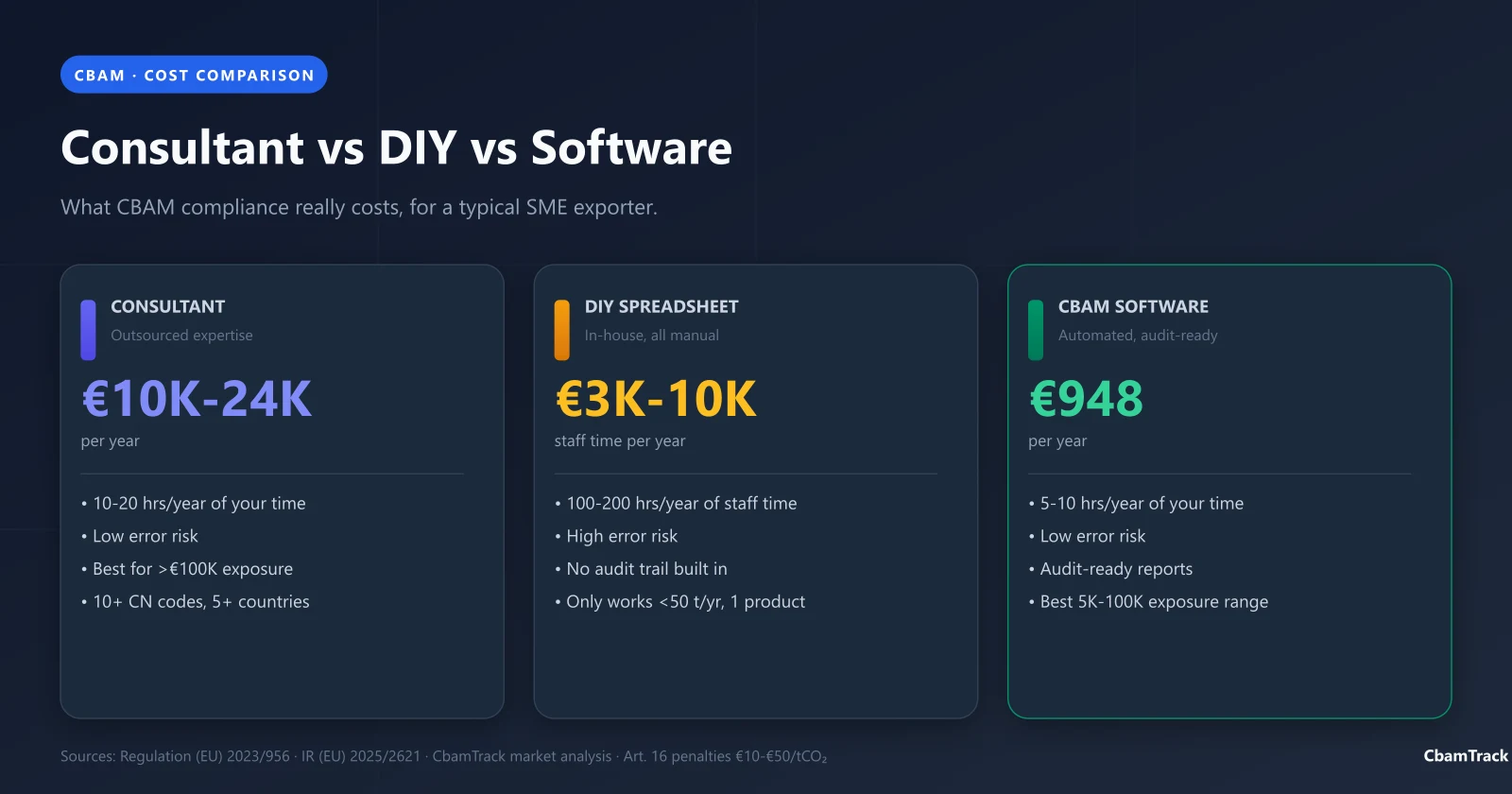
- Direct cost: €5,000 to €50,000/year for a consultant, €0 for DIY, €948/year (€79/mo) for software
- Time cost: 10-20 hours/year with a consultant, 100-200 hours/year with DIY, 5-10 hours/year with software
- Error risk: low with a consultant or software, high with DIY, and it usually shows up as a staff member pulled off their real work
The option with the lowest invoice is rarely the cheapest one.
The consultant route
Consultants make sense once the exposure is big. Roughly: €500K or more in annual CBAM exposure, a supply chain crossing several countries, or an audit already scheduled. At that scale a consultant's fee is small next to what a filing mistake costs. Don't skimp there.
You're buying people who think about CBAM every day, documentation that survives an audit, and advice specific to your products rather than a generic template. They take the liability on too, which is worth something on its own.
The downsides aren't hidden: €5,000 to €50,000 a year, and you depend on one firm that moves on its own calendar. Turnaround runs days to weeks. Good ones are hard to find. I've watched a company burn a month looking for a CBAM consultant who had capacity, then pay a premium.
A realistic engagement looks like this:
| Phase | Hours | Cost |
|---|---|---|
| Initial assessment | 8-16 hours | €1,500-€3,000 |
| Data collection and analysis | 16-40 hours | €3,000-€8,000 |
| Report generation | 8-16 hours | €1,500-€3,000 |
| Ongoing support (annual) | 20-40 hours | €4,000-€10,000 |
| Total annual cost | 52-112 hours | €10,000-€24,000 |
DIY: the spreadsheet trap
DIY only works in a narrow window: under 50 tonnes a year, one product, and someone on the team who genuinely knows Excel. Inside that window it's fine. No invoices, full control over every calculation, nobody outside the company touching your data.
The trap is time. Whoever carries this is usually the production manager or the finance lead, and they still have their day job. They also have to track regulation changes, keep figures straight, and hand your customer something an importer can actually submit. There's no audit trail unless you built one, and nobody does.
The hours run 40-60 for a single product and country, 80-120 once you're at 3-5 products across 2-3 countries, and 150-200 for 10+ products in 5+ countries. At €50/hour that's €2,000-€3,000, then €4,000-€6,000, then €7,500-€10,000 a year, with error risk climbing at every step.
Penalties for misreporting started at €10 per tonne of misreported CO₂ during the transitional phase (IR (EU) 2023/1773, Article 16). Under the definitive regime the operative penalty is €100 per tonne of CO₂e for failure to surrender certificates (Regulation (EU) 2023/956, Article 26).
The option nobody priced in
I built one of these tools, so read this knowing that. Software runs €948/year, less than an hour of most consultants' time, and it does the calculations, pulls the emission factors, and generates the report. Your people spend 5-10 hours a year on it.
You lose the tailor-made feel. You gain consistent calculations, reports that survive an audit, live ETS prices, and a warning when a number looks off. It fits most SMEs shipping between 10 and 5,000 tonnes a year. The honest limit is data quality: if your records are a mess, the tool flags it, but somebody still has to clean it up.
The whole thing as a table
Three variables come up in every conversation I have: volume, product count, and audit history.
| Factor | Consultant | DIY | Software |
|---|---|---|---|
| Annual CBAM exposure | >€100,000 | <€5,000 | €5,000-€100,000 |
| Products | 10+ CN codes | 1-2 CN codes | 1-50 CN codes |
| Countries | 5+ | 1 | 1-10 |
| Staff expertise | None | Excel expert | Basic computer skills |
| Time available | <20 hours/year | >100 hours/year | <20 hours/year |
| Audit risk | High | Low | Medium |
| Budget | >€10,000/year | €0 | <€1,000/year |
Under €5,000 in annual exposure, DIY or software both work. From €5,000 to €100,000, software is the sweet spot. Above that, or with 10+ CN codes or 5+ countries, look at a consultant or a hybrid. The one case where I'd push a consultant regardless: no expertise in the building and an audit already on the calendar.
Three companies, run the math
A small steel exporter moving 200 tonnes a year to the EU: a consultant runs about €12,000 a year and takes 15 hours of your time. DIY costs roughly €3,000 in staff time over 80 hours, with moderate accuracy. The tool costs €948 and about 5 hours, with high accuracy.
Double the tonnage to 500 and the gap only widens. The consultant is €18,000 and 25 hours. DIY lands around €5,000 over 120 hours. The software is still €948 and 8 hours.
At 2,000 tonnes across 10 CN codes it stops being a fair fight: €35,000 and 40 hours for a consultant, about €10,000 over 200 hours doing it in-house with low accuracy, and €948 with 12 hours on the tool.
What an error costs you
Read Article 26 of Regulation (EU) 2023/956 before you bet on DIY. During the transitional phase a wrong CN code ran €10-€50 per tonne, and it shows up in about 30% of the first-time filings I've reviewed. Missing indirect emissions, €10-€50 per tonne, roughly 25%. Wrong country factors, same range, about 20%. File late and it's €10-€100 per tonne, around 15% of the time. Incomplete documentation, €50-€100, roughly 10%. Those figures are impressions from transitional-phase filings, not a published dataset, so read them as rough order rather than precision.
In practice: a 200-tonne steel exporter who files late with a wrong CN code is looking at €5,000 plus €6,000, which is €11,000 in penalties. More than 11 years of the software subscription, gone in a single filing.
The route most end up on
Not many companies pick one option and stay with it. A lot start with a consultant for the initial assessment in year one, €3,000 to €5,000, and run quarterly reporting on software at €948/year, for a year total of €4,000 to €6,000. From year two the consultant drops to a retainer for audits, €1,000 to €2,000/year, and the software does the rest: €1,948 to €2,948/year. By year three it's mostly automation, and the team just enters production data for 5-10 hours a year.
Work your own situation through it
Under 50 tonnes a year to the EU, DIY or software is fine. Under 500, software. Up to 5,000, software or a hybrid. Past that, you're in hybrid or consultant territory.
Then look at your product count. Three or fewer CN codes, software handles it. Four to ten, software or a hybrid. More than ten, you want a consultant in the mix.
And whether you've been audited. No audit yet, software gets you ready. Already been through one, go hybrid or consultant.
Where I land
Asked directly: DIY is rarely the cheapest route once staff time and error risk are on the table. Consultants earn their keep on complex cases, say over €100K in exposure, and are overkill for most small companies. For 90% of companies, software has the best cost-to-accuracy ratio, and the hybrid route, a consultant for setup and software for the ongoing work, is the safest way to start.
One compliance error can cost more than a decade of the subscription. Run your own numbers through the free CBAM calculator and see where you land.
Frequently asked questions
How much does a CBAM consultant cost?
Between €10,000 and €24,000 per year for most SMEs, depending on complexity. Initial assessments cost €1,500-€3,000.
Can I do CBAM compliance myself?
Yes, if you have under 50 tonnes/year and a single product. For anything larger, the time investment (100-200 hours/year) and error risk make DIY expensive.
Is CBAM software enough for compliance?
For 90% of SMEs, yes. The software handles calculations, factor lookups, and report generation. You still need to enter your production data; the software does the rest.
What's the cheapest CBAM compliance option?
DIY spreadsheets have the lowest direct cost (€0), but the highest hidden cost in staff time and error risk. CBAM software at €948/year offers the best value for most companies.
Regulation status
| Field | Value |
|---|---|
| Last reviewed | 2026-07-27 |
| Based on | Regulation (EU) 2023/956, IR (EU) 2025/2621 |
| Applies to | CBAM permanent phase (2026+) |
References
- EU Regulation 2023/956
- IR (EU) 2025/2621
- European Commission CBAM Q&A
- Try the free CBAM calculator
- Compare pricing plans
Last updated: August 12, 2026
Related: CBAM Certificate Cost Formula | CBAM Compliance: What to Do Right Now | What Is CBAM?
Important Financial Disclaimer
The financial figures, cost estimates, and compliance scenarios discussed in this article are for informational purposes only. Actual CBAM liability depends on your specific import profile, verified emission data, and regulatory interpretations. Consult a qualified CBAM advisor or customs professional before making compliance decisions.
This article was researched and written with AI assistance. Figures and regulatory references are cross-checked against official EU sources (EUR-Lex, European Commission CBAM page) and updated when the rules change.
R. Emrah Gökkaya
I built CbamTrack because I saw SME exporters struggling with spreadsheets and confusing regulations. Every article here reflects what I've learned implementing IR 2025/2621-compliant calculations, integrating live EU ETS pricing, and building the emission factor database that powers our platform.
View full author bio →Ready to simplify your CBAM compliance?
Subscribe today and generate your first CBAM report in minutes.