
Building an EU ETS Price Pipeline
Key Takeaways
- This guide covers engineering reporting requirements based on IR (EU) 2025/2621 and EU Regulation 2023/956
- All emission factors and CN codes referenced are verified against the latest EU implementing regulations
- Practical steps and common mistakes are drawn from hands-on implementation experience with the CbamTrack platform
From the team behind CbamTrack
We built this guide based on hands-on experience implementing CBAM compliance for SME importers. The calculations and workflows described here power our own platform — this is not theory, it's what we ship.
CBAM certificate costs are directly tied to EU ETS allowance prices — for the 2026 compliance year it's a quarterly average, from 2027 it switches to a weekly average of EU ETS auction closing prices. That sounds like a simple "call an API, store a number" problem. It isn't. Here's why, and how it shaped the engineering behind CBAMTrack's certificate cost calculator.
"EU ETS allowance prices are determined through weekly auctions conducted by the European Energy Exchange (EEX) on behalf of the European Commission." — European Commission, EU ETS Auctioning
EU ETS Price History
| Year | Low (€/tCO₂) | Average (€/tCO₂) | High (€/tCO₂) |
|---|---|---|---|
| 2023 | 56 | 84 | 104 |
| 2024 | 52 | 68 | 82 |
| 2025 | 58 | 72 | 88 |
| 2026 (est.) | 65 | 78 | 95 |
Source: European Energy Exchange (EEX) auction data, European Commission
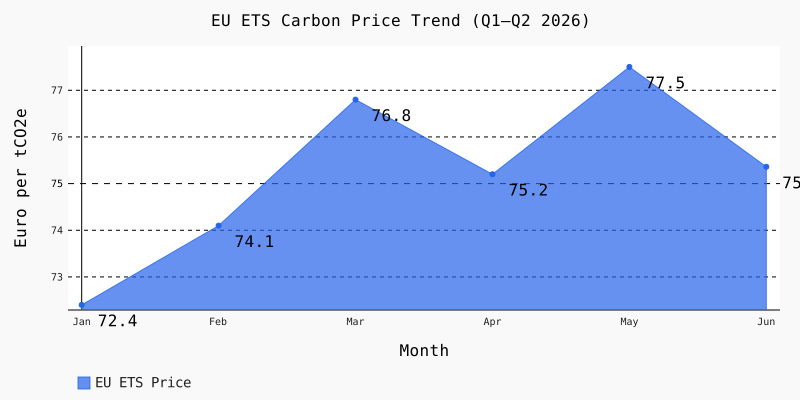
Here's how the price tracker actually works, and why it's built the way it is.
Why "just call an API" doesn't hold up
A compliance tool can't have an "unlucky day." If the price feed goes down and someone generates a CBAM cost estimate off a stale or missing value, that's not a cosmetic bug — it's a number they might actually budget against. The design constraint from day one was: the system must never silently serve a wrong or missing price. It either serves a verified price or it visibly tells you it couldn't.
That single constraint is what turned this from a fetch-and-cache script into a proper fallback chain, with an explicit "stale as of [date]" flag surfaced in the UI whenever the most recent verified price can't be confirmed.
Each tier only activates if the one above it fails or returns data outside a sanity-check range — a >15% single-day swing gets flagged for review rather than trusted blindly. Carbon markets are volatile, but not usually that volatile.
Storing prices the way CBAM actually needs them
The tricky part isn't fetching a price — it's storing it in a shape that supports both compliance-year rules at once, since 2026 uses a quarterly average and 2027 onward uses a weekly average.
// Simplified schema
model EtsPrice {
  id                String   @id @default(cuid())
  date              DateTime @unique
  priceEurPerTonne  Decimal
  source            String   // which tier of the fallback chain produced this
  isStale           Boolean  @default(false)
  fetchedAt         DateTime @default(now())
}
Storing raw daily prices — not pre-computed averages — turned out to be the right call. When the 2026→2027 pricing rule change landed, there was no backfill needed. The averaging logic just reads a different window.
Postgres, not Redis
The obvious instinct for a "fetch a price, cache it, serve it fast" problem is Redis. We didn't use it, and don't expect to.
The read pattern for ETS prices isn't "give me the latest value as fast as possible" — it's "give me the volume-weighted average over this specific window, where the window definition itself depends on which compliance year we're calculating for." That's a query with a WHERE date BETWEEN and a GROUP BY, not a key lookup. Redis is excellent at the thing we don't need (sub-millisecond single-key reads) and clumsy at the thing we do need (windowed aggregation over a time series with a variable boundary rule).
Postgres gives us that aggregation for free, in SQL, against data that's already sitting next to every other table the calculation engine touches — no cross-service joins, no second system to keep in sync, no cache-invalidation bugs when a price gets corrected after the fact (which does happen; auction data occasionally gets revised after publication).
There's a simpler reason too: running lean matters. Every extra piece of infrastructure is one more thing to operate and monitor. A Redis instance earns its keep when there's a genuine hot-path latency problem. A handful of daily price rows, queried a few hundred times a day, doesn't have that problem — Postgres with an index on date handles it without any extra thought.
normalizePeriod() and displayPeriod()
CBAM reporting periods don't map cleanly onto calendar quarters once you factor in the transition between the quarterly-average rule (2026) and weekly-average rule (2027+). Two small helpers get used everywhere in the reporting engine, not just the price tracker:
// normalizePeriod: takes a raw date range and returns the
// canonical CBAM reporting period it belongs to, accounting
// for the 2026/2027 averaging-rule boundary
function normalizePeriod(date: Date): CbamPeriod { ... }

// displayPeriod: takes a normalized period and returns the
// human-readable label used across the UI and PDF reports
function displayPeriod(period: CbamPeriod): string { ... }
Having a single source of truth for "what period does this date belong to, and what do we call it" closed off a category of bug we hit early on: a report and its underlying price data disagreeing about which quarter they were describing, because one code path used raw dates and another used the period label.
What we'd do differently
If we were starting over, the sanity-check/anomaly-flagging logic would come before the happy-path fetch-and-store logic, not after. It got added reactively once a bad data day showed up in staging — a source returning a cached value from three weeks earlier without any indication it was stale. In a compliance product, "silently wrong" is a worse failure mode than "loudly broken."
Why this matters beyond CBAM
If you're building anything that depends on an external price or regulatory feed — carbon markets, FX rates, commodity indices — three questions are worth asking before writing the fetch logic:
- What happens the day your source is down?
- What happens the day your source returns a number that's technically valid but wrong?
- Does your storage layer assume today's aggregation rule will still be true next year?
Getting those answers right up front is cheaper than retrofitting them after someone asks why their number changed.
Key Takeaways
- ETS prices are determined through weekly EEX auctions on behalf of the European Commission
- 2026 uses quarterly averages; 2027 onward uses weekly averages
- A fallback chain prevents serving stale or missing prices
- Postgres handles windowed aggregation better than Redis for this use case
- Sanity-check logic should be built before the happy path, not after
The certificate cost formula this price data feeds into — including the phase-in schedule and sector-specific benchmarks — is covered in how to calculate your CBAM certificate costs. Or try the live calculator directly.
Important Financial Disclaimer
The financial figures, cost estimates, and compliance scenarios discussed in this article are for informational purposes only. Actual CBAM liability depends on your specific import profile, verified emission data, and regulatory interpretations. Consult a qualified CBAM advisor or customs professional before making compliance decisions.
This article was researched and written with AI assistance. Figures and regulatory references are cross-checked against official EU sources (EUR-Lex, European Commission CBAM page) and updated when the rules change.
R. Emrah Gökkaya
I built CbamTrack because I saw SME exporters struggling with spreadsheets and confusing regulations. Every article here reflects what I've learned implementing IR 2025/2621-compliant calculations, integrating live EU ETS pricing, and building the emission factor database that powers our platform.
View full author bio →Ready to simplify your CBAM compliance?
Subscribe today and generate your first CBAM report in minutes.