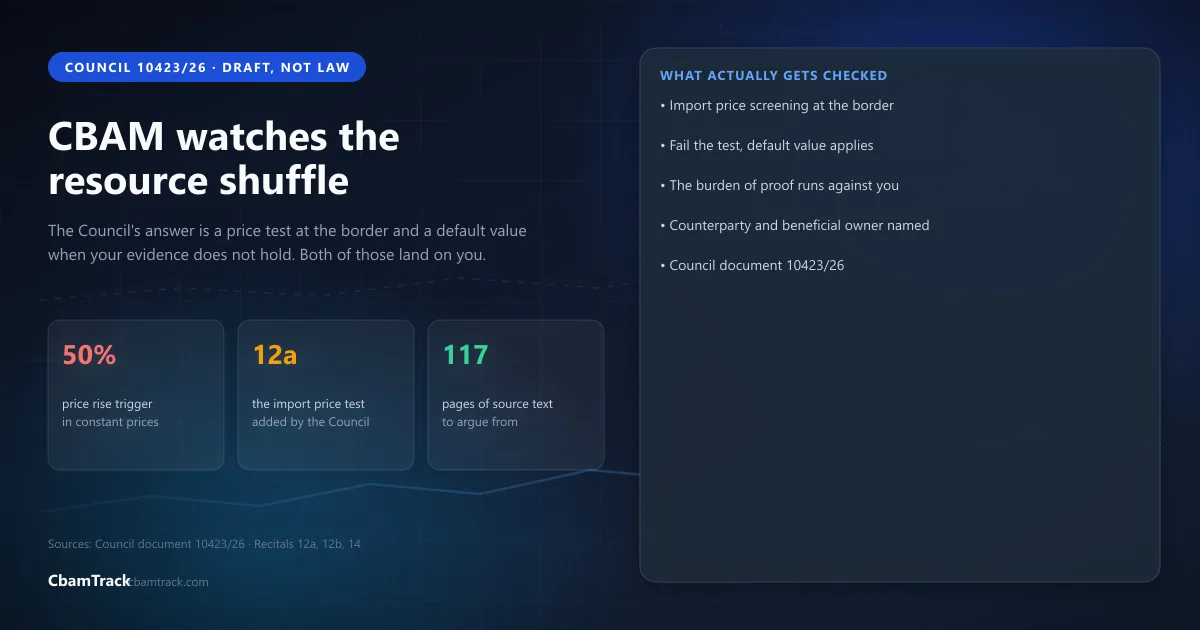
CBAM Resource Shuffling: The Evidence Now Falls on You
Key Takeaways
- This guide covers a legislative proposal that is not yet adopted. The Council agreed its general approach on 12 June 2026 and Parliament adopted its position on 15 September 2026; negotiations are still ongoing
- Every quotation and citation is checked against the primary Council and Parliament documents, not summaries or press coverage
- Practical steps and common mistakes are drawn from hands-on implementation experience with the CbamTrack platform
From the team behind CbamTrack
We track this file from the primary Council and Parliament documents and describe only what the texts actually say. Where a rule is not yet in force, we say so in the text itself.
There is a way to make CBAM look cheap without changing anything about your production. Ship your cleanest tonnes to Europe and your dirtier tonnes elsewhere. Because CBAM charges on the emissions actually embedded in what arrives, every unit that arrives gets a flattering factor. Your total emissions do not move. Your CBAM bill does.
The European Union has a name for this, and as of 12 June 2026 it has a legal answer.
"Abusive practices include, but are not limited to, practices of harmful resource shuffling, where actors, controlling several production sites, with different technologies of production with material differences in emission intensity purposefully export to the Union the cleanest proportion of the goods without engaging in any structural decarbonisation strategy for the rest of the production of those goods, while not being exposed to a carbon price comparable to that applicable to production of the same goods in the Union."
Council of the European Union, document 10423/26, recital (12a)
Read that definition carefully, because every clause in it is an evasion route that an auditor will test. Several production sites. Different technologies. Material differences in emission intensity. Purposeful selection of the cleanest proportion. No structural decarbonisation elsewhere. No comparable carbon price at home.
If your group runs a clean electric arc furnace line and a dirty induction line, that is the profile. Most large steel and aluminium groups have exactly this profile, and most of them had no reason to think about it until now.
Why the existing net does not catch this
CBAM is a border mechanism. It prices the emissions of goods that cross into the Union. A producer that decarbonises genuinely faces a rising CBAM bill on the clean tonnes, because actual emissions are lower. That is the incentive working as designed.
Resource shuffling inverts the incentive. It lets a multi-site operator report a low average without decarbonising anything, by selecting which tonnes cross the border. The Union producer competing against that shipment is exposed to CBAM costs on production that is genuinely more carbon-intensive. That producer's operations become unviable, and the emissions reduction inside the Union is replaced by an increase somewhere else:
"Due to harmful resource shuffling, imported goods could make Union producers' operations unviable. The subsequent emissions reduction in the Union due to disappearance of EU production would be offset by an increase in emissions in the rest of the world, if the demand for these goods in the Union would be covered by third-country production, meaning carbon leakage occurs."
Council document 10423/26, recital (12a)
So this is not a revenue question. It is the specific failure mode that CBAM's own recital 3 says it exists to prevent.
The burden has moved to the declarant, and the sanction is the default value
Here is the part that should change how you read your responsibilities. The Commission is not going to prove shuffling occurred. It is going to ask you to prove it did not, and if you cannot, your numbers are replaced.
"For this subset of CN codes and origins, it is justified to introduce by way of implementing acts conditions to be fulfilled by operators and to request evidence to be provided by the CBAM declarant, demonstrating that no harmful resource shuffling has occurred, given the high degree of uncertainty of the market response to the introduction of a financial liability corresponding to the emissions embedded in goods imported into the EU and the parallel phase-out of EU ETS free allocations. ... Where the evidence provided by the CBAM declarant is insufficient to demonstrate that no harmful resource shuffling has occurred, the CBAM declaration would have to be based on the default values as determined by the Commission."
Council document 10423/26, recital (12b)
Three consequences follow, and they are worth internalising separately.
The obligation attaches to operators and the evidence to the CBAM declarant. The operator establishes the conditions; the declarant carries the evidence obligation into the customs declaration. In a group structure these are different legal persons and often different countries, which is why the coordination question in the checklist below is not a detail.
The remedy is not a penalty. It is a switch to default values. Default values are set for the country of origin, and where no reliable data exists for that country the fallback is the average emission of the 10 countries with the highest emission intensities (default values and markups). They will almost certainly be worse for a clean producer than your actual figure. The sanction for an unproven clean claim is to be taxed as though you had no clean claim.
The trigger is deliberately narrow. The risk "can be circumscribed to a subset of CN codes and origins of the goods listed in Annex I". So the Commission is expected to name specific CN codes and specific origins, not to apply a general anti-fraud test to every shipment. Until that implementing act names your code and origin, this provision has no operational effect. When it does, it switches on fully.
What the Commission weighs when deciding where to look
Recital (12b) sets out four reference points for identifying where the risk is high. They are worth reading as a self-assessment, because they tell you the shape of the case the Commission intends to build.
The climate ambition of the third country. A country with a carbon price comparable to the Union's has weaker incentive to shuffle. A country with a weak or absent carbon price has every incentive.
The heterogeneity of emissions at country level. A country whose imports to the EU are uniformly low-carbon cannot be shuffling much, because there is no clean subset to select.
The volume of goods imported into the Union from the third country. Shuffling needs enough flow to move the Union market.
The economic incentives for operators to engage in it. This is where the ETS free allocation phase-out lands. As free allocation falls at the installation level, the gap between a carbon-priced site and an unprotected site widens, and selection becomes more valuable.
Expect the scope to concentrate on steel and aluminium
The text does not draw a sector line. Recital (12b) says only that the risk "can be circumscribed to a subset of CN codes and origins of the goods listed in Annex I", and the implementing act is what will name that subset. Where it lands is an analysis rather than a citation: the mechanism sits inside the amending regulation that also extends the CBAM to downstream steel and aluminium-intensive goods, and the recital's actor profile - "controlling several production sites, with different technologies of production with material differences in emission intensity" - describes multi-site steel and aluminium groups. The downstream expansion and the anti-circumvention provisions are two faces of the same file.
For cement, fertiliser, hydrogen and electricity, a multi-site clean-dirty selection arbitrage is much harder to construct because the product is far more homogeneous in emissions and less routable between sites. If you are in those sectors this post is background reading, not an action list.
The 50% price test is the exit, not the entry
This is the part most likely to be misread, so it is worth separating cleanly. The Commission and the Council agreed two distinct mechanisms for resource shuffling, and only one of them has a numeric trigger.
The evidence conditions above are the entry mechanism. They impose obligations on operators and declarants, with default values as the sanction. No percentage, no price test.
The 50% test belongs to a different provision, the new temporary exemption procedure in Article 27a. It is what the Commission must show in order to take a good out of CBAM scope because the internal market is being severely harmed. That post covers it separately, because the trigger, the calendar and the ETS consequences are all specific to that mechanism.
The distinction matters because they point in opposite directions. Article 27a relieves goods. The resource shuffling provisions constrain exporters. Bundling them in your reading will produce the wrong compliance posture.
Other abusive practices follow a different track
Resource shuffling is not the only abuse the text targets. The Council deliberately separates it, because the remedy is different.
"To enable a swift reaction in the case of evidence pointing towards a high risk of abusive practices other than harmful resource shuffling, the Commission should be empowered to adopt delegated acts to lay down, the description of the abusive practice identified, the method used for identifying the combinations of good and origin at risk of the abusive practice identified, the measures to be taken with a view to addressing the risk of abusive practices as well as the evidence demonstrating that such abusive practices have not occurred. Where the Commission finds sufficient evidence pointing towards a high risk of abusive practices other than harmful resource shuffling, the Commission should be required to act by way of delegated acts within three months after the finding."
Council document 10423/26, recital (14)
A delegated act for non-shuffling abuses carries a hard three-month clock from the Commission's finding. The procedural difference is the point: a delegated act is adopted under an empowerment act and is subject to a scrutiny period in which the European Parliament and the Council may object, while an implementing act is adopted through comitology and carries no such objection right. When the Commission has to build the case itself rather than test the operator's evidence, the co-legislators keep a say. That is why the choice of instrument here is deliberate.
The practical difference for you: the burden structure in recital (12b) is a reverse burden on you. The burden in recital (14) is on the Commission to identify a specific practice, identify the codes and origins at risk, and specify the evidence. If you are worried about an abuse that is not shuffling, the Commission has to name it first.
Monitoring is a standing obligation, not a one-off
The Commission is directed to keep watching, and to review the scheme on a cycle. The review clause requires an assessment of "practices of circumvention", the "application of penalties in Member States", the "application of the single mass-based threshold, including the possibility of increasing that threshold and of introducing a supplementary consignment-based threshold", and the "impact of attributing emissions to pre-consumer scrap as a precursor on the effectiveness of the CBAM in addressing the risk of carbon leakage".
That list is useful for a different reason. It tells you which levers are live in the same file. The 50-tonne de minimis threshold is not fixed. Pre-consumer scrap attribution is in play, and the scrap evidence rule in the pre-consumer scrap post is part of the same package.
None of this is law yet
The Council reached a general approach on 12 June 2026. That is a negotiating position within the co-legislative procedure, not an enacted regulation. Parliament adopted its own position for negotiations on 15 September 2026, by 464 votes to 50 with 159 abstentions, and is now ready to start negotiations with the Council. Both sides have moved; neither has adopted anything. Nothing here applies until agreement and publication in the Official Journal of the European Union, and the resource shuffling implementing act does not exist yet at all. It is something the Commission is directed to bring forward "as soon as possible after entry into force of this regulation".
Parliament's text also sharpens the anti-circumvention side: MEPs lowered the threshold at which a change to a good counts as circumvention, tightened the rule so it "targets only arrangements set up purely to avoid the CBAM, and not normal business decisions", and want the Commission to be able to apply the true country of origin's default values where a pattern of circumvention is established.
So this is preparation work, not a filing requirement. The correct sequence is:
- Map whether your group controls multiple production sites with materially different emission intensity, on the same good and within the same CN code. Most groups do. Very few have looked at this.
- Identify which of your sites would supply the cleanest tonnes to the EU on a full decarbonisation trajectory, and which would supply the dirtiest. If the answer is that the clean site is the one expanding, you are already exposed conceptually.
- Establish, per site, whether a carbon price comparable to the EU's applies. A group that decarbonises partly because of an ETS obligation at home is in a very different position from one exporting from a country with no effective carbon price.
- Build the evidence trail now: site-level activity data, allocation logic, production volumes by destination. The default value switch is the sanction, and evidence assembled after the fact is weaker than evidence assembled continuously.
- Watch for the implementing act naming specific CN codes and origins. Until it does, the obligation is dormant and the cost of preparing is low.
What you should not do is assume the absence of an implementing act means absence of exposure. The direction of travel is the same in both negotiating texts, and the Commission has been unusually explicit about wanting to act fast.
Frequently asked questions
What is resource shuffling in CBAM terms?
It is the practice where an operator controlling several sites with different emission intensities purposefully exports its cleanest proportion to the EU without decarbonising the rest of its production, and is not subject to a carbon price comparable to the EU's. It lowers the CBAM bill without lowering emissions.
Who has to prove that shuffling did not happen?
The CBAM declarant carries the evidence obligation into the CBAM declaration. Conditions are imposed on operators. Where the declarant's evidence is insufficient, the declaration must be based on the Commission's default values.
What happens if the declarant cannot produce the evidence?
The declaration defaults to the Commission's default values for that good and origin. It is a replacement of your reported figure, not an additional penalty on top of it.
Does this apply to all CBAM goods?
It is expected to be circumscribed to a subset of CN codes and origins where a high likelihood of harmful resource shuffling can be demonstrated. In practice this points at steel and aluminium, not cement, fertiliser, hydrogen or electricity.
Is there a numeric trigger for the resource shuffling conditions?
No. The 50% price increase test belongs to the separate temporary exemption procedure in Article 27a, which relieves goods from scope. The resource shuffling conditions are imposed through an implementing act without a stated numeric threshold.
What is the sanction for non-shuffling abusive practices?
The Commission must identify the practice, the method for identifying the goods and origins at risk, the measures, and the evidence required, and must act by delegated act within three months of finding sufficient evidence. Parliament and the Council can object.
When does this take effect?
It does not yet. The Council agreed a general approach on 12 June 2026 and Parliament adopted its negotiating position on 15 September 2026, but negotiations between the two have not concluded, the regulation is not in the Official Journal, and the implementing act has not been adopted either.
What should a multi-site producer do now?
Map your sites by emission intensity, work out which would supply the cleanest EU-bound tonnes, and start assembling site-level evidence now. The default value switch is the sanction, so continuous evidence is cheaper than reconstructing it.
Regulation status
| Field | Value |
|---|---|
| Last reviewed | 2026-10-08 |
| Based on | Council document 10423/26 of 12 June 2026, recitals (3), (12a), (12b), (12c), (14); EP plenary position of 15 September 2026 |
| Legal status | Council general approach and EP negotiating position. Not adopted. Not in force. |
References
- Council of the European Union, document 10423/26, general approach, 12 June 2026
- European Parliament, press release 20260911IPR47450, plenary adopts CBAM negotiating position, 15 September 2026
- European Parliament, press release 20260629IPR46212, ENVI committee position, 6 July 2026
- Regulation (EU) 2023/956, the CBAM Regulation, EUR-Lex
- European Commission, CBAM legislation and guidance
- CBAM downstream expansion and the anti-circumvention package
- CBAM default values and markups
- The 50-tonne de minimis threshold
- How to calculate embedded emissions
Council document 10423/26 was consulted as a local copy (117 pages). Interinstitutional file 2025/0419 (COD). Recital references are to the numbered recitals in that document; page references in the source run from 8 to 9 and 47 to 49. The Parliament position is the first-reading negotiating mandate adopted in plenary on 15 September 2026, reported in press release 20260911IPR47450.
Last updated: October 2026 | Sources: Council document 10423/26 (12 June 2026); European Parliament plenary position, 15 September 2026
Important Financial Disclaimer
The financial figures, cost estimates, and compliance scenarios discussed in this article are for informational purposes only. Actual CBAM liability depends on your specific import profile, verified emission data, and regulatory interpretations. Consult a qualified CBAM advisor or customs professional before making compliance decisions.
This article was researched and written with AI assistance. Figures, quotations and legislative status are cross-checked against primary EU sources (Council documents, European Parliament press releases, EUR-Lex). This file is not adopted yet; the article states the current negotiating status explicitly.
R. Emrah Gökkaya
I built CbamTrack because I saw SME exporters struggling with spreadsheets and confusing regulations. Every article here reflects what I've learned implementing IR 2025/2621-compliant calculations, integrating live EU ETS pricing, and building the emission factor database that powers our platform.
View full author bio →Ready to simplify your CBAM compliance?
Subscribe today and generate your first CBAM report in minutes.