CBAM Downstream Expansion: Parliament's 2026 Vote
Key Takeaways
- This guide covers compliance reporting requirements based on IR (EU) 2025/2621 and EU Regulation 2023/956
- All emission factors and CN codes referenced are verified against the latest EU implementing regulations
- Practical steps and common mistakes are drawn from hands-on implementation experience with the CbamTrack platform
From the team behind CbamTrack
We built this guide based on hands-on experience implementing CBAM compliance for SME importers. The calculations and workflows described here power our own platform — this is not theory, it's what we ship.
Parliament has voted on the next CBAM phase. Four changes matter more than the product list
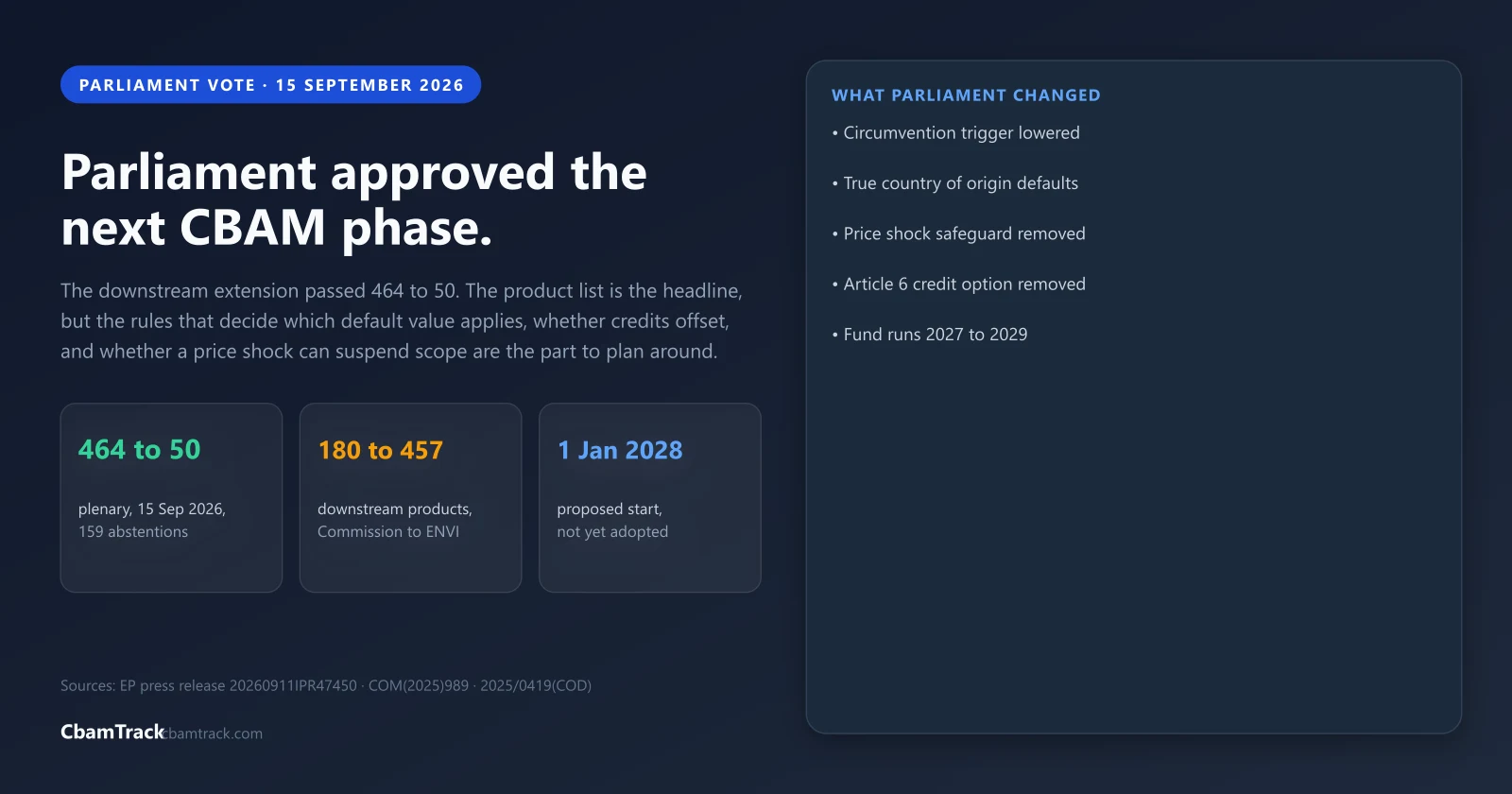
On 15 September 2026 the European Parliament adopted its negotiating position on the file that would extend CBAM to downstream goods. The vote was 464 in favour, 50 against, 159 abstentions.
The product list is what will get the headlines. It is not what should drive your planning. Four substantive changes carried in the same mandate, around how circumvention is detected, which country a default value attaches to, what happens to carbon credits, and whether a price shock can suspend the whole mechanism, will do more to change your numbers than the exact count of product codes.
This is a negotiating mandate, not law. Nothing in it changes what you owe for 2026. Parliament has set its opening position, the Council has set one of its own, and negotiators now have to produce a single text.
What was actually voted
| File | Parliament position | Rapporteur |
|---|---|---|
| CBAM scope extension and anti-circumvention | 464 to 50, 159 abstentions | Mohammed Chahim, S&D, Netherlands |
| Temporary Decarbonisation Fund | 433 to 97, 146 abstentions | Pascal Canfin, Renew, France |
The two files were voted separately and passed with different margins. The fund carried a much stronger majority than the scope extension. That matters, because the fund is the mechanism that buys political support for the extension from EU producers, and a comfortable majority there means the trade-off is unlikely to be reopened from scratch in negotiations.
The product list grew at every stage
| Stage | Date | Product count published for that stage |
|---|---|---|
| Commission proposal COM(2025)989 | 17 December 2025 | about 180 |
| Council general approach | 12 June 2026 | none published; described only as wider than the proposal |
| Parliament ENVI committee position | 6 July 2026 | 457 |
| Parliament plenary mandate | 15 September 2026 | none published; count left to negotiations with the Council |
Only two of the four stages carry a published number. Where the cell says none, the absence is the fact: the Council and the plenary both moved the scope without publishing a count, so no figure is available to quote.
The Commission proposed adding roughly 180 steel and aluminium intensive downstream products, with application from 1 January 2028. The Parliament environment committee reported a much longer list of 457 products, and the plenary confirmed the direction without publishing a single headline figure of its own.
What the plenary did publish is the character of the goods. The mandate covers finished steel and aluminium articles, and Parliament named them in its own communication: fasteners, wire, springs and household articles. If your exposure today is zero because what you import is a component rather than a basic material, that is precisely the gap this file is meant to close.
Two limits are worth holding on to. The Commission explicitly left finished passenger cars out of its proposal, and Parliament's mandate did not put the full appliance range into scope just because individual household items appear on the list. And the direction of travel is not finished. The Commission's own review, under Article 30(2) of the CBAM Regulation, treats cement, fertiliser and hydrogen downstream products as candidates for a later extension.
Change one: the circumvention test got narrower and its trigger got lower
Parliament moved the anti-circumvention rules in two directions at once.
The first is a lower trigger. Under the mandate, a smaller change to how a good is presented can be enough to qualify as circumvention. The second is a narrower test. Parliament tightened the rule so that it targets only arrangements whose purpose is to avoid CBAM, and explicitly not ordinary commercial decisions taken to reduce a company's costs.
Read together, those are a sharper instrument aimed at a smaller target. The safe harbour for normal procurement behaviour is wider, and the penalty for engineering a transaction to sit below the threshold is closer.
If your exposure sits anywhere near the de minimis threshold, the mechanics in the de minimis threshold explainer are where the practical effect will land.
Change two: the default value can follow the goods back to where they came from
Parliament wants to empower the Commission to apply the default values of the true country of origin where a pattern of circumvention is established.
None of the four changes carries more operational risk than this one, and it is easy to miss because it is phrased as a procedural power rather than a rate change.
Today, a default value is a function of the origin you declare. Under the mandate, where the Commission establishes a pattern of circumvention, the default attaches to where the goods actually originated. For any supply chain that routes goods through an intermediate country before they reach you, this is the difference between a number you can look up and a number someone else decides about you.
If your goods pass through a third country, or your supplier's ownership chain is not obvious from the invoice, this is the item to raise with them.
Change three: a new carve-out for electricity used to hold the grid stable
Parliament added an exemption for electricity flows from non-EU countries used by grid operators to keep networks stable.
This is a new exception rather than a modification of an existing one. It also sits alongside a separate objective in COM(2025)989, which restructures how the embedded emissions of imported electricity are calculated and changes both Annex IV and the declaration content under Article 6.
For anyone modelling electricity inputs today, that is the part of this file to watch. Electricity is the one CBAM input where the methodology, not just the scope, is moving.
Change four: Parliament removed two Commission options
The price-shock safeguard was rejected. The Commission had proposed a mechanism that would allow goods to be taken out of CBAM scope in defined price conditions. Parliament refused it. In its place, MEPs want a mechanism to temporarily redirect CBAM revenues from the affected goods to the sectors suffering the price shock.
The substitution is the substantive part. Redirecting revenue keeps the obligation intact and moves the relief downstream. Suspending scope would have removed the obligation for the affected goods altogether.
The Article 6 credit option was removed. Parliament deleted the Commission's proposal to allow Paris Agreement Article 6 carbon credits to count against CBAM obligations.
Nothing else in the mandate is this unambiguous. It is also the change most likely to have commercial consequences. Parliament tied the deletion to the upcoming revision of the Emissions Trading System, on the logic that the question belongs there. If any part of your compliance or commercial model priced voluntary or internationally transferred carbon credits into a CBAM position, that assumption is now fragile. The deduction that survives is a carbon price effectively paid in the country of origin.
The fund moved earlier and opened wider
The Temporary Decarbonisation Fund is the companion file, and Parliament passed it 433 to 97.
Three changes against the Commission proposal:
- Timing. Support runs from 2027 to 2029, rather than from 2028 alone.
- Eligibility. The fund opens to fertiliser producers and to downstream users facing higher carbon-related input costs, with urea, ammonium nitrate and ammonium sulphate added to the list of eligible goods.
- Residual revenue. Leftover money is redirected to the EU's international climate finance commitments under the Paris Agreement rather than returned to Member States.
The rationale given for the fertiliser extension is food security, since fertiliser is a strategic input. The reason downstream operators matter for CBAM is different and more direct: the whole purpose of the fund is to offset the competitive pressure that the downstream extension creates for EU producers buying CBAM covered inputs.
You do not apply to this fund. You care about it because it affects whether your EU suppliers can stay in the market at a price you can afford, and because it tells you how hard the trade-off will be to settle in negotiations.
The gap Parliament did not touch: exports
CBAM regulates imports. It does not do anything about exports, and Parliament's mandate did not change that.
A European manufacturer selling machinery into Asia, Latin America, Africa or North America pays EU carbon costs on the steel and aluminium it buys inside the EU, and recovers none of them. A competitor outside the EU, in a country with no comparable carbon price, faces no such burden. The mechanism corrects carbon leakage into the EU and leaves export leakage in place.
This was the principal objection raised in industry reaction to the vote. EUROMETAL, the European Federation of Steel, Tubes and Metals Distribution and Trading, made three arguments in its statement of 15 September 2026: that the product list remains incomplete however wide it gets, that a 2028 start date arrives too late to prevent further relocation, and that there is still no mechanism for EU exporters carrying carbon costs into third markets. It also argued that anti-dumping, anti-subsidy and safeguard measures compound the cost gap independently of carbon.
That is an advocacy position rather than a legal one, and it should be read as such. It is useful because it tells you who will be pushing hardest in negotiations, and on which two files. An incomplete list and a late start date are both cheap for an industry to concede in a trilogue and expensive to concede publicly.
What to do now
Nothing about your current obligations changes. Your 2026 scope, your phase-in factors, your default value lookups and your certificate cost calculation all stand as they are. If you are checking one thing today, check that nothing in your model assumes the safeguard survives, because Parliament removed it.
What is worth doing while the text is still moving:
- Re-run your top CN codes against the wider list. Take the ten codes that account for most of your import volume and check each against the 180 product annex in the Commission proposal, then against the 457 product committee list. The direction of travel is one way. If a code looks close to the boundary, work at 8-digit CN level rather than 6-digit HS, since that is the granularity the lists are built on and it decides which rules you land under.
- Ask your suppliers where the goods originate, not where they ship from. The true country of origin default mechanism is the item most likely to change a rate without warning you.
- Remove credits from your CBAM cost model. The mandate deletes the Article 6 route. Model what you actually pay in the country of origin.
- Treat 1 January 2028 as a proposal, not a deadline. It is the Commission's intended application date in an unadopted file. Both the date and the product count can still move.
- Track the fund as well as the scope. Its eligibility rules determine how much relief EU producers get, which feeds back into the pricing you are quoted.
What is not settled
The file still has to survive negotiation. Parliament's position is its opening position, the Council adopted a general approach on 12 June 2026, and every element of the mandate can still change before a final act is published.
Specifically still open: the final product list, the final application date, the exact circumvention thresholds, the criteria on which the true country of origin mechanism operates, and the fund's eligibility rules. All of it has to be agreed and published before it can apply, and the timetable has to be tight enough for a 2028 start date to remain reachable.
Two things are settled enough to plan against. The 2026 definitive phase is untouched. And the direction of the extension is expansion rather than retreat, so modelling a 2028 position with a broader scope and a fluid product list is a better assumption than modelling a smaller one.
Related: CBAM mid-year 2026 update | CBAM de minimis threshold | CBAM certificate cost calculation | CBAM practical implementation guide
Frequently asked questions
Is the downstream extension law now?
No. Parliament adopted its negotiating position on 15 September 2026. The file is 2025/0419(COD) under the ordinary legislative procedure, so it needs agreement with the Council and a joint text before it can be adopted. Nothing in the mandate creates a new obligation for 2026.
When would downstream products start being charged?
The Commission proposal COM(2025)989 sets 1 January 2028 as the intended application date for the downstream extension. That is a proposed date in a file that has not been adopted, and the final act can change both the date and the product list.
Does this vote change my 2026 CBAM calculation?
No. The vote concerns a future extension. Your 2026 scope, phase-in and default values are set by the CBAM Regulation and its implementing acts, including the corrected default values in IR (EU) 2026/1740.
Can Paris Agreement Article 6 credits reduce my CBAM bill?
Under Parliament's mandate, no. MEPs removed the option to count Article 6 carbon credits against CBAM obligations, on the stated reasoning that the question should be settled in the upcoming Emissions Trading System revision. The deduction that remains is a carbon price effectively paid in the country of origin.
My product is a component rather than a basic material. Should I do anything?
Start monitoring now rather than at adoption. The mandate covers finished steel and aluminium articles, and Parliament specifically named fasteners, wire, springs and household articles. Identify your CN codes and check them against the proposal annex while the list is still moving.
What is the Temporary Decarbonisation Fund, and do I care about it?
It is a fund supporting EU producers exposed to carbon leakage. Parliament positioned it to run from 2027 to 2029, open to fertiliser producers and to downstream users of CBAM covered goods. You are not an applicant. You care because it determines how much support EU producers receive against the new import competition, which flows into the price your EU customers can pay.
Regulation status
| Field | Value |
|---|---|
| Last reviewed | 2026-09-27 |
| Instrument | COM(2025)989, procedure 2025/0419(COD) |
| Status | Parliament negotiating position adopted 15 September 2026, not adopted law |
| Proposed application | 1 January 2028 for the downstream extension |
References
- European Parliament press release, CBAM extension and loopholes, 15 September 2026, ref 20260911IPR47450
- European Parliament adopted text, 15 September 2026. Report reference A10-0201/2026, linked as "Adopted text" from the press release above.
- European Parliament press release, ENVI committee position, 6 July 2026, ref 20260629IPR46212
- COM(2025)989, proposal to extend CBAM to downstream products, EUR-Lex
- COM(2025)989, full text, European Parliament
- Agence Europe, ENVI committee extends CBAM to 457 products, 6 July 2026
- EUROMETAL, "Reaction to the European Parliament's position on extending CBAM to downstream products", press release, 15 September 2026. Industry association statement, not law. Independently corroborates the vote date.
- EPRS briefing, CBAM extension to downstream products
- European Commission, CBAM legislation and guidance
- Regulation (EU) 2023/956, the CBAM Regulation, EUR-Lex
Last updated: September 2026 | Sources: COM(2025)989, European Parliament press releases 20260911IPR47450 and 20260629IPR46212, Regulation (EU) 2023/956
Important Financial Disclaimer
The financial figures, cost estimates, and compliance scenarios discussed in this article are for informational purposes only. Actual CBAM liability depends on your specific import profile, verified emission data, and regulatory interpretations. Consult a qualified CBAM advisor or customs professional before making compliance decisions.
This article was researched and written with AI assistance. Figures and regulatory references are cross-checked against official EU sources (EUR-Lex, European Commission CBAM page) and updated when the rules change.
R. Emrah Gökkaya
I built CbamTrack because I saw SME exporters struggling with spreadsheets and confusing regulations. Every article here reflects what I've learned implementing IR 2025/2621-compliant calculations, integrating live EU ETS pricing, and building the emission factor database that powers our platform.
View full author bio →Ready to simplify your CBAM compliance?
Subscribe today and generate your first CBAM report in minutes.