EU ETS Free Allocation & the CBAM Factor
Key Takeaways
- This guide covers technical reporting requirements based on IR (EU) 2025/2621 and EU Regulation 2023/956
- All emission factors and CN codes referenced are verified against the latest EU implementing regulations
- Practical steps and common mistakes are drawn from hands-on implementation experience with the CbamTrack platform
From the team behind CbamTrack
We built this guide based on hands-on experience implementing CBAM compliance for SME importers. The calculations and workflows described here power our own platform — this is not theory, it's what we ship.
The system CBAM is replacing
The EU ETS is the EU's main tool for pricing carbon. Since 2013, auctioning has been the default allocation method. But sectors exposed to carbon leakage receive free allowances to protect competitiveness.
"The EU has adopted a carbon border adjustment mechanism (CBAM) to replace the existing system of free allocation. The CBAM aims to ensure that imported goods are subject to the same carbon costs as those produced within the EU. However, the CBAM is still being phased in, and it does not cover all sectors exposed to the risk of carbon leakage." EPRS Briefing, "Free allocation in the EU emissions trading system" (July 2026)
The headline numbers:
- The EU ETS has cut covered emissions by more than half since 2005, on track for a 62% reduction by 2030
- Auctioning generated over €258 billion in revenues (2013 to 2025)
- 57% of allowances must be auctioned (EU ETS Directive), capping what can be given away free
Who gets free allocation
| Category | Free allocation | Phase-out |
|---|---|---|
| CBAM sectors (iron/steel, aluminium, cement, fertilisers, hydrogen) | 100% of benchmark (top-10% performers) | Via CBAM factor, ends 2034 |
| Non-CBAM sectors (refineries, chemicals, ceramics, glass, pulp/paper) | 100% of benchmark | No phase-out deadline announced |
| District heating | 30% | 2030 |
| Less-exposed sectors (not on carbon leakage list) | 30% (2025), falling | 2030 |
The carbon leakage list (CLL) is set by Delegated Decision (EU) 2019/708, based on emissions and trade intensity indicators. Being on the list means 100% of benchmark level free.
How benchmarks work
Benchmarks are based on the average emissions of the 10% most efficient sub-installations in the EU/EEA:
- 52 product benchmarks plus 2 fallback benchmarks (heat, fuel)
- 2021 to 2025 period: based on 2016 to 2017 emission intensities
- 2026 to 2030 period: based on 2021 to 2022 intensities; the Commission updated the list on 29 June 2026
- A cross-sectoral correction factor (CSCF) caps total free allocation to preserve the 57% auctioning share (currently at 100%, meaning no reduction; the 10% most efficient installations are exempt from CSCF reductions)
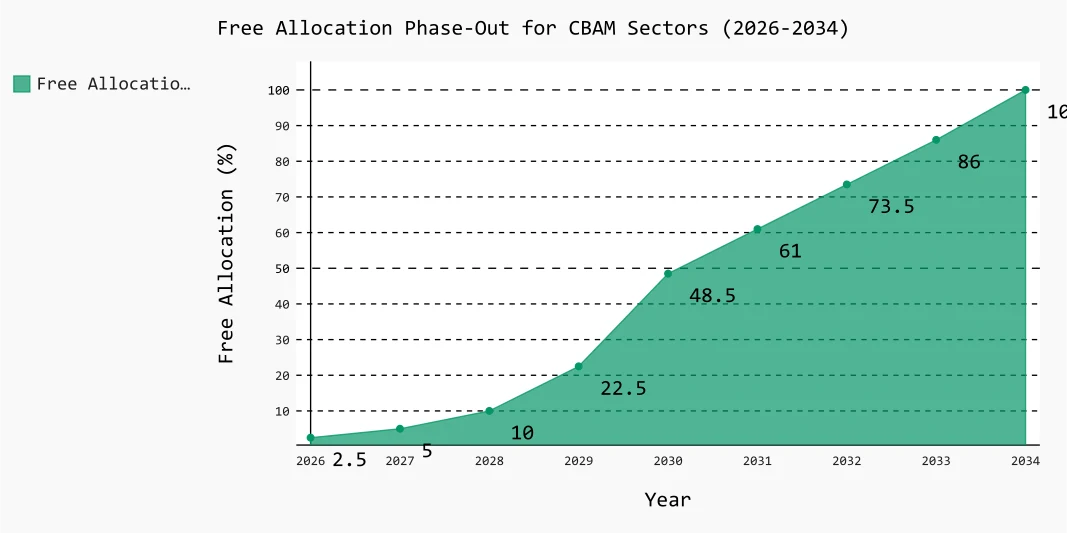
The CBAM factor schedule
| Year | CBAM factor | Free allocation remaining |
|---|---|---|
| 2026 | 2.5% | 97.5% |
| 2027 | 5% | 95% |
| 2028 | 10% | 90% |
| 2029 | 22.5% | 77.5% |
| 2030 | 48.5% | 51.5% |
| 2031 | 61% | 39% |
| 2032 | 73.5% | 26.5% |
| 2033 | 86% | 14% |
| 2034 | 100% | 0% |
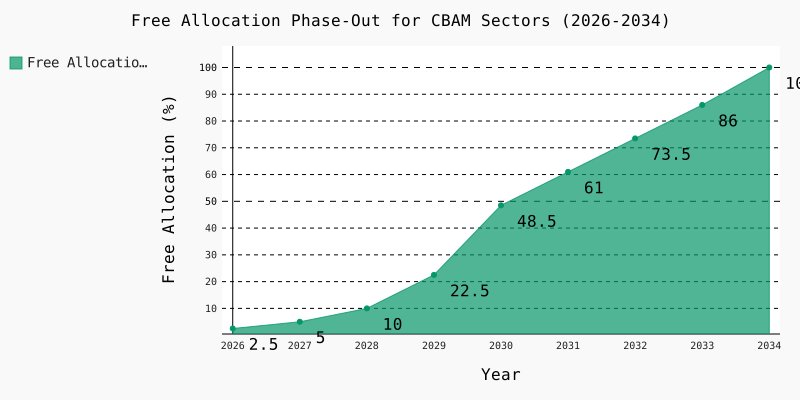
"The CBAM factor will cease to apply from 2034, when free allocation for CBAM for these goods will end entirely." EPRS Briefing (July 2026)
Dynamic allocation and conditionalities
Dynamic allocation (since 2021) corrects free allowances when an installation's average activity level changes by 15% or more (rolling two-year average), aligning allocation with actual production.
Conditionalities (from the 2023 ETS revision) come in non-cumulative types:
- Energy efficiency: 20% reduction if an audited installation hasn't implemented recommended measures
- Climate neutrality plans: 20% reduction if emissions exceed the 80th percentile of the benchmark curve without an approved plan
Under the July 2026 proposal (COM(2026) 616), free allocation from 2031 would additionally be conditional on submitting and implementing an EU-based decarbonisation investment plan — 80% allocated on approved plan, the remaining 20% only after verified emission reductions.
The July 2026 revision
Two parallel processes are underway:
- Benchmark Regulation, the implementing act setting revised 2026 to 2030 free allocation values (Commission updated benchmarks 29 June 2026, via Implementing Regulation (EU) 2026/1412)
- ETS Directive revision, proposed 17 July 2026 (COM(2026) 616), redefining the ETS post-2030
The Commission Staff Working Document accompanying the revision (SWD(2026) 616) covers carbon leakage prevention measures, a 20 MW threshold question, and new sectors and technologies including waste management and carbon capture and utilisation (CCU).
A note on the 2034 date — it may not hold. The table above reflects the law as it stands today (Regulation 2023/956): CBAM factor rising to 100% and free allocation ending in 2034. But the July 2026 ETS revision proposal would slow this. Under the proposal, 15% of the free allocation phased out by the CBAM factor is reintroduced starting in 2028, and the phase-out is delayed: free allocation would hold at 15% from 2034 to 2037, reaching zero only in 2038. Concretely, the proposed free-allocation-remaining figures would be 91.5% (2028), 81% (2029), 59% (2030), 37.5% (2032), 15% (2034-2037) and 0% (2038), instead of the current-law values above. This is a Commission proposal, not yet law, but it is a live legislative track. Treat today's 2034 table as the current legal default and the 2038 extension as the likely outcome if the proposal survives co-decision.
Why importers should care: CBAM and the ETS are two halves of one design. As free allocation phases out (the CBAM factor above), the border price on imports rises to match, directly affecting what you pay for CBAM goods. If the phase-out slows to 2038, the effective CBAM price rises more gradually than the current schedule suggests — worth folding into any multi-year CBAM cost projection.
The short version
- CBAM replaces free allocation for covered sectors; today's law phases it out to zero by 2034, though the July 2026 ETS proposal would slow this to 2038
- Non-CBAM sectors (chemicals, ceramics, glass, pulp/paper) have no announced phase-out deadline
- Benchmarks are set by the top 10% of EU installations, 52 product benchmarks, updated for 2026 to 2030 on 29 June 2026
- Dynamic allocation corrects free allowances when production moves 15% either way
- The July 2026 ETS revision will shape free allocation post-2030, and CBAM with it
Related: CBAM Certificate Cost Formula | How to Calculate Embedded Emissions | EU ETS Price Tracker
Frequently asked questions
When does free allocation for CBAM sectors end?
Under current law, 2034 — the CBAM factor rises from 2.5% (2026) to 100% (2034), so free allocation falls from 97.5% to 0%. The July 2026 ETS revision proposal would slow this, reintroducing 15% from 2028 and extending the phase-out to 2038 for CBAM sectors. Not yet law.
Are all industries losing free allocation?
Only CBAM-covered sectors have a defined phase-out. Refineries, chemicals, ceramics, glass and pulp/paper (non-CBAM sectors) keep free allocation with no announced deadline.
How are benchmarks updated?
Every five years based on the best 10% of installations. The 2026 to 2030 benchmarks use 2021 to 2022 emission intensities.
Regulation status
| Field | Value |
|---|---|
| Last reviewed | 2026-09-09 |
| Based on | EPRS Briefing PE 789.377 (July 2026), EU ETS Directive 2003/87/EC, Commission Implementing Regulation (EU) 2021/447 and (EU) 2026/1412, SWD(2026) 616, COM(2026) 616 (proposal — 2038 phase-out extension) |
| Applies to | CBAM permanent phase (2026+), EU ETS Phase IV (2026-2030) |
References
- EPRS, Free allocation in the EU emissions trading system (PE 789.377, July 2026)
- EU ETS Directive 2003/87/EC
- Commission Implementing Regulation (EU) 2021/447
- Commission Implementing Regulation (EU) 2026/1412 (benchmarks 2026-2030)
- COM(2026) 616 — ETS Directive revision proposal (17 July 2026)
- EU Regulation 2023/956
- European Commission, CBAM
Last updated: September 2026 | Sources: EPRS Briefing PE 789.377 (July 2026), EU ETS Directive, SWD(2026) 616 final, COM(2026) 616
This article was researched and written with AI assistance. Figures and regulatory references are cross-checked against official EU sources (EUR-Lex, European Commission CBAM page) and updated when the rules change.
R. Emrah Gökkaya
I built CbamTrack because I saw SME exporters struggling with spreadsheets and confusing regulations. Every article here reflects what I've learned implementing IR 2025/2621-compliant calculations, integrating live EU ETS pricing, and building the emission factor database that powers our platform.
View full author bio →Ready to simplify your CBAM compliance?
Subscribe today and generate your first CBAM report in minutes.