What Data Does Your EU Customer Need for CBAM?
Key Takeaways
- This guide covers guide reporting requirements based on IR (EU) 2025/2621 and EU Regulation 2023/956
- All emission factors and CN codes referenced are verified against the latest EU implementing regulations
- Practical steps and common mistakes are drawn from hands-on implementation experience with the CbamTrack platform
From the team behind CbamTrack
We built this guide based on hands-on experience implementing CBAM compliance for SME importers. The calculations and workflows described here power our own platform — this is not theory, it's what we ship.
If you supply steel, aluminium, cement, or fertiliser to an EU buyer, you'll get an email soon — maybe you already have. They'll ask for emissions data. They need it for CBAM.
This guide explains exactly what data they need, how to prepare it, and what happens if you can't provide it.
The Email You'll Get
It sounds something like this:
"As part of our CBAM compliance, we need to collect embedded emissions data for the products we import from you. Can you provide your production route, energy consumption, and emissions per tonne?"
CBAM's permanent phase started January 1, 2026. EU importers must now report the carbon emissions embedded in everything they import. They can't do that without data from their suppliers.
What Your EU Customer Needs
For every product they buy from you, they need this:
| Data Category | Specific Data Points |
|---|---|
| Product identification | Product name, CN code (8-digit), quantity (tonnes) |
| Production route | BF-BOF, EAF, DRI-EAF, etc. |
| Direct emissions | CO₂ from fuel combustion on-site |
| Indirect emissions | CO₂ from purchased electricity |
| Energy consumption | Electricity (kWh), gas (m³), coal (kg), fuel (litres) |
| Country of origin | Where production happens |
| Carbon price paid | Any carbon tax or ETS paid in your country |
Sector note on indirect emissions: For cement and fertilisers, both direct and indirect emissions are chargeable. For steel, aluminium, hydrogen, and electricity (Annex II sectors under Regulation 2023/956 Art. 7(1)), indirect emissions from electricity must be reported but do not affect the CBAM certificate cost. Your electricity source matters for reporting purposes only, not for the final chargeable amount.
The EU provides a standardised format for this called the Communication Sheet. It's not complicated — just a structured way to share the data above.
What Happens If You Don't Provide Data
Your EU customer has two options:
- Use your actual emissions data — if you provide it
- Use EU default values — if you don't
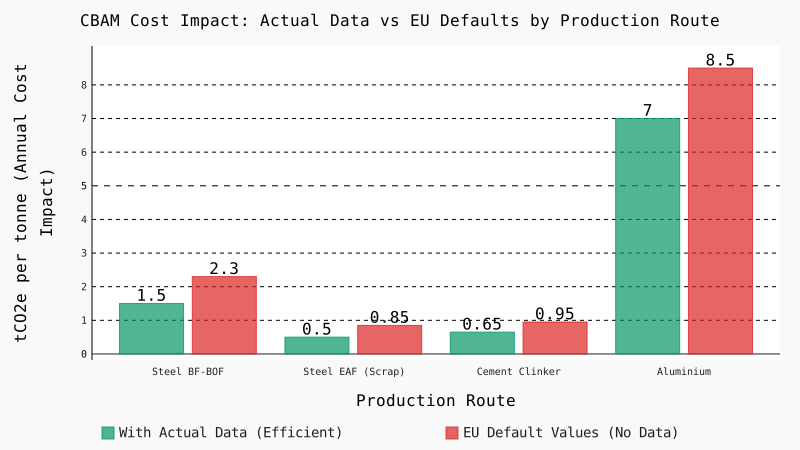
Default values are set deliberately high. They assume worst-case production methods. On top of that, they carry a markup that starts at +10% in 2026 and reaches +30% by 2028 (IR (EU) 2025/2621).
| Scenario | Your Emissions | EU Default | Cost to Your Customer |
|---|---|---|---|
| You provide actual data (efficient production) | 1.50 t CO₂/t | — | Baseline |
| You don't provide data | — | 2.30 t CO₂/t | ~5.9x more (chargeable) |
| Default value markup (2026) | — | +10% above benchmark | 2026 only |
| Default value markup (2028) | — | +30% above benchmark | 2028 only |
These are not "53% more" — that figure comes from a simplified formula that skips the benchmark deduction and materially understates the gap. The real comparison uses the CBAM certificate formula, which subtracts the free-allocation benchmark before applying the certificate price.
Worked example at a 1.370 tCO₂/t benchmark (steel BF-BOF), CBAM factor 97.5% in 2026:
- Benchmark deduction: 1.370 × 0.975 = 1.336 tCO₂/t
- Actual data (1.50): chargeable = 1.50 − 1.336 = 0.164 tCO₂/t
- Default (2.30): chargeable = 2.30 − 1.336 = 0.964 tCO₂/t
- Ratio: 0.964 ÷ 0.164 ≈ 5.9x — roughly 488% more expensive, not 53%
Here's the business reality: your EU customer pays more when you don't provide data. Over time, they'll look for suppliers who do.
How to Prepare Your Data
Step 1: Find Your CN Codes
Ask your EU customer which CN codes they import from you. Common ones:
| Product | CN Code |
|---|---|
| Steel rebar | 7214 |
| Steel flat products | 7208-7212 |
| Aluminium ingots | 7601 |
| Cement clinker | 2523 10 00 |
Step 2: Document Your Production Route
For each product, answer:
- What furnace or process do you use? (BF-BOF, EAF, DRI-EAF)
- What fuel do you burn on-site? (coal, coke, natural gas, fuel oil)
- What electricity do you consume? (grid, dedicated plant, renewable PPA)
Step 3: Collect 12 Months of Energy Data
| Data Source | What to Collect |
|---|---|
| Electricity bills | kWh consumed per month |
| Gas bills | m³ consumed per month |
| Fuel receipts | Litres or kg of fuel consumed |
| Coal or coke purchases | Tonnes purchased |
Step 4: Calculate Emissions Per Tonne
Formula: Total emissions from all sources ÷ Total production in tonnes
Example for a steel producer:
- Total emissions: 2,250 t CO₂ per year
- Total production: 1,000 tonnes per year
- Emissions per tonne: 2.25 t CO₂ per tonne
Step 5: Share With Your EU Customer
Use the EU Communication Sheet format. Even a simple email with the data points works.
What If You Don't Have Data?
Many suppliers don't track emissions yet. Here's what you can do:
Option A: Estimate Using Your Production Route
If you know your production method, you can estimate:
| Production Route | Typical Emissions Range (CBAM-chargeable) |
|---|---|
| Steel BF-BOF | 1.85 – 2.30 t CO₂ per tonne |
| Steel EAF (scrap) | 0.40 – 0.70 t CO₂ per tonne |
| Aluminium (direct only) | 1.50 – 2.20 t CO₂ per tonne |
| Cement clinker | 0.60 – 0.85 t CO₂ per tonne |
Aluminium note: Under Annex II, only direct emissions from smelting are chargeable for CBAM. Indirect emissions from electricity are reported but excluded from certificate cost calculations. This means an aluminium smelter's electricity source (gas, hydro, coal) does not affect its CBAM obligation — only smelting technology (pre-bake vs Søderberg) matters. The 1.50–2.20 t CO₂/t range above reflects direct emissions only.
Option B: Tell Them What You Know
Even partial data helps:
- "We use a blast furnace with coal"
- "Our electricity comes from the national grid"
- "We produce 500 tonnes per year"
Your EU customer can work with this to produce a better estimate than using defaults.
Why This Matters for Both of You
| You (Supplier) | Your EU Customer (Importer) |
|---|---|
| Lower CBAM cost for your products | Lower CBAM certificate obligation |
| Preferred supplier status | More accurate CBAM declarations |
| Competitive advantage | Reduced audit risk |
| Better customer relationship | Easier compliance |
When you provide actual emissions data, both sides win. It's not just a compliance burden — it's a competitive advantage.
Key Takeaways
- Your EU customer needs: CN code, production route, energy consumption, and emissions per tonne
- Default values are deliberately expensive — providing data saves both of you money
- You don't need a consultant to prepare this data
- Even partial data helps more than nothing
- Suppliers who respond quickly become preferred suppliers
Frequently Asked Questions
Will my EU customer stop buying from me if I don't provide data?
Not immediately. But they'll pay more in CBAM costs for your products. Over time, they may shift to suppliers who provide data, because those suppliers are cheaper.
Is emissions data confidential?
You can share it directly with your EU customer through a secure channel. It doesn't get published publicly.
Do I need a consultant to calculate my emissions?
No. If you know your production route and energy consumption, you can calculate emissions in under an hour using free tools.
What format does my EU customer need?
The EU Communication Sheet format is standard, but even a simple email with the key data points works.
Regulation Status
| Field | Value |
|---|---|
| Last reviewed | 2026-07-27 |
| Based on | Regulation (EU) 2023/956, IR (EU) 2025/2621 |
| Applies to | CBAM permanent phase (2026+) |
References
- EU Regulation 2023/956
- IR (EU) 2025/2621
- European Commission CBAM Q&A
- Free CBAM cost calculator
- CBAM reporting software
Last updated: July 27, 2026
Related: CBAM Compliance: What to Do Right Now | CBAM Certificate Cost Formula | CBAM for Gulf/MENA Exporters
This article was researched and written with AI assistance. Figures and regulatory references are cross-checked against official EU sources (EUR-Lex, European Commission CBAM page) and updated when the rules change.
R. Emrah Gökkaya
I built CbamTrack because I saw SME exporters struggling with spreadsheets and confusing regulations. Every article here reflects what I've learned implementing IR 2025/2621-compliant calculations, integrating live EU ETS pricing, and building the emission factor database that powers our platform.
View full author bio →Ready to simplify your CBAM compliance?
Subscribe today and generate your first CBAM report in minutes.