How to Collect Carbon Data From Your Suppliers
Key Takeaways
- This guide covers guide reporting requirements based on IR (EU) 2025/2621 and EU Regulation 2023/956
- All emission factors and CN codes referenced are verified against the latest EU implementing regulations
- Practical steps and common mistakes are drawn from hands-on implementation experience with the CbamTrack platform
From the team behind CbamTrack
We built this guide based on hands-on experience implementing CBAM compliance for SME importers. The calculations and workflows described here power our own platform — this is not theory, it's what we ship.
You didn't make the steel, but you're the one who has to explain it
CBAM puts the reporting obligation on the EU importer. Not the mill, not the smelter, not the trader in between. You. Every tonne of steel, aluminium, cement or fertiliser that crosses the border carries an emissions figure, and if that figure isn't in your declaration, it's missing because nobody handed it to you.
Most importers discover this far too late. The supplier says they don't have it. The default value the Commission publishes for that country and production route is significantly worse than what the plant actually emits, and there's a markup on top that climbs every year.
None of that is your supplier's fault, and most of it is avoidable. What's avoidable is the scramble. Collecting supplier data is an operations problem, not a data problem, and it runs on a calendar you can plan backwards from.
The obligation is asymmetric on purpose
The regulation was written this way. An EU importer is the party in the chain that is established in the Union, holds the authorisation, and files with the registry. Chasing emissions data up and down a supply chain that runs through several tiers of intermediaries is exactly the administrative mess a border mechanism is meant to price in.
What this means practically is that you cannot delegate the data problem. You can delegate the chasing. Some of it, anyway.
The full specification of what a supplier owes you, field by field, is in What Data Does Your EU Customer Need for CBAM?. That post is written from the supplier's side and covers the data categories, the Communication Sheet contents, and how emissions get calculated per tonne. This one is about the part that usually gets skipped: running the collection itself.
Work backwards from the filing date
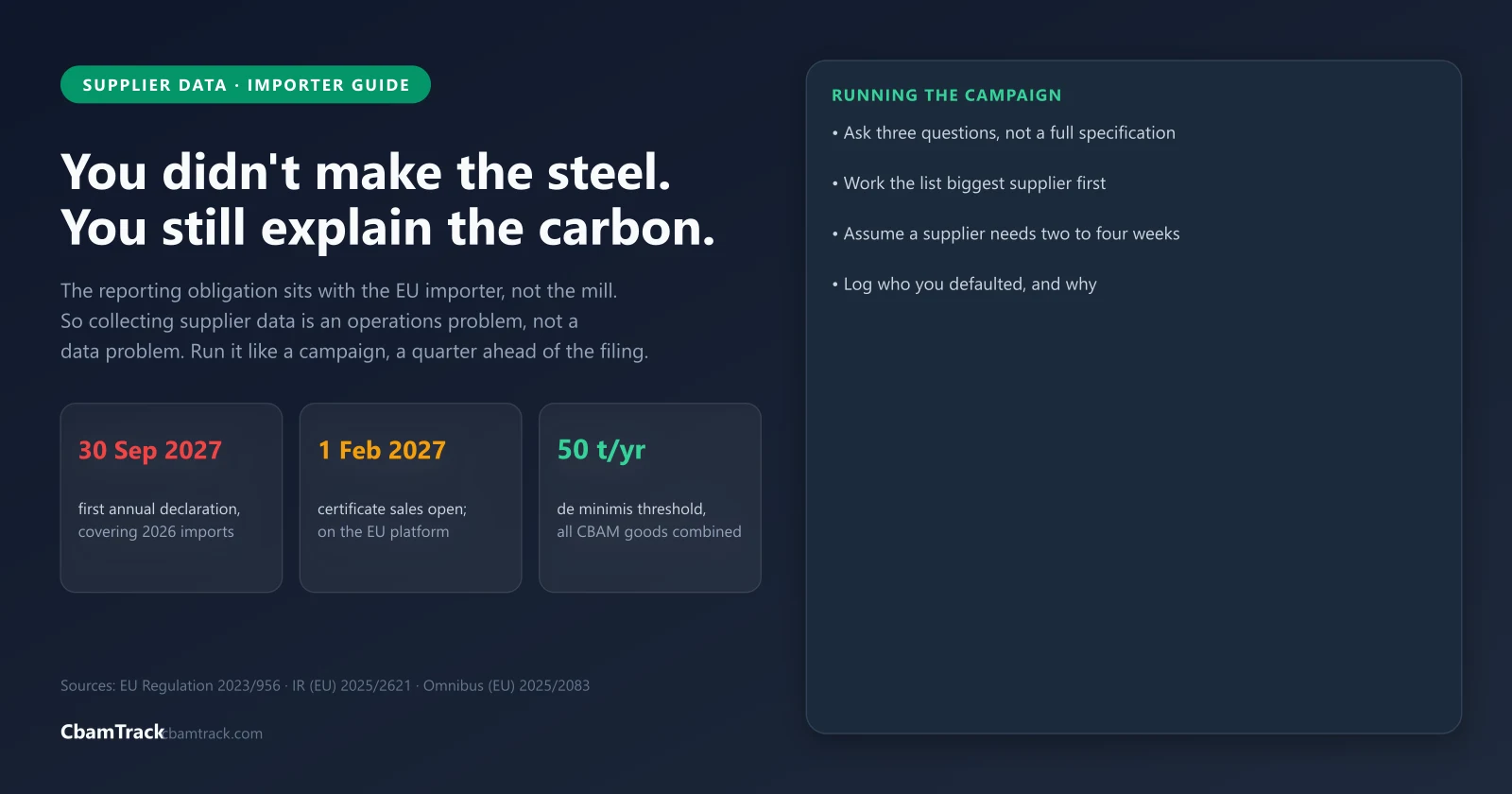
Here's the constraint that should set your schedule. Under the permanent regime the first annual declaration, covering 2026 imports, is due 30 September 2027. Certificate sales open on the common central platform on 1 February 2027. And if your combined imports of CBAM goods stay under 50 tonnes a year, Omnibus (EU) 2025/2083 exempts you from authorisation, declaration and certificates altogether.
| Milestone | Date | What it forces |
|---|---|---|
| Certificate sales open | 1 February 2027 | You buy against a balance you should already know |
| First annual declaration (2026 imports) | 30 September 2027 | The filing your 2026 data has to survive |
| Data collection window you actually control | 2026, quarter by quarter | Where the work has to happen |
A supplier who takes four weeks to answer is not being difficult. They're being normal. But if you start that conversation in August 2026, a four-week turnaround eats your entire margin for error, and you'll be relying on default values for products where you had a real chance of getting actual figures.
Start the outreach in the same quarter you need the data. Not the quarter before you file.
Three questions, not a questionnaire
Here's where most campaigns fail. Someone builds a spreadsheet with every field in the CBAM specification, attaches it to an email, and gets silence. The supplier opens it, sees a form built for regulators, and closes the tab.
You don't need all of it up front. Three questions will get you moving, and everything else can be derived or defaulted later:
- What production route does this product come from? Blast furnace basic oxygen furnace, electric arc furnace, direct reduction, or something else.
- Roughly what energy does the plant consume per tonne? Electricity in kWh, gas in cubic metres, coal or coke in kilograms.
- Which country and facility does this shipment originate from?
Production route plus energy consumption is the input to the actual emissions number. Country of origin decides which published default applies if something is missing. Everything else on the specification, including carbon price paid in the country of origin, is a refinement you can chase in a second pass once the supplier is actually talking to you.
The rule I'd hold to: get the plant-level data moving, then improve it. A verified figure for the main production route is worth more than a perfect questionnaire that comes back empty.
The email that gets answered
Keep it short, keep it non-technical, and make the ask concrete. Suppliers who have never heard of CBAM will disengage the moment they see the acronym.
Subject: Quick question about how [product] is made
Hi [name],
We're preparing our 2026 carbon reporting for goods we buy from you, and we need to describe the production process behind [product].
Three things would help:
- How is it produced? (for example blast furnace, electric arc furnace, or direct reduction)
- What energy does the plant use per tonne? Electricity, gas, coal, or a mix?
- Which facility does this come from?
Rough figures are fine to start. If you'd rather fill in a standard form, I can send one over. This is for a regulatory filing on our side, not an audit of your plant.
Thanks, [name]
Two details in that draft do more work than the rest.
The phrase "rough figures are fine" removes the fear that a wrong number creates liability. Most suppliers stall on fear, not effort. And "not an audit of your plant" addresses the other objection, which is that emissions data feels like it could be used against them later.
Offer the form as an option rather than a demand. Some plants have a compliance person who will happily complete a structured document and will not reply to a free-text question.
Work the list biggest supplier first
Sequencing matters more than the wording of the email. Two reasons.
Your largest suppliers by volume have the most to lose if you shift volume to a competitor who does supply data. They also have the most capacity to answer, because they have compliance staff. Start there and you build a track record of replies before you reach the long tail.
Your smallest suppliers are the ones who will not answer, and they are also the ones where defaults hurt least, because the tonnage is small. That's the useful reframe: you are not trying to win every response. You are trying to protect the tonnage that actually moves your certificate balance.
These are planning assumptions, not published response-rate data. Replace them with the response rates you track in your own files once you have a season or two of history.
| Supplier profile | What usually happens | Where to spend the effort |
|---|---|---|
| Large, export-focused, has compliance staff | Answers, often within 2 to 4 weeks | Chase hard, verify the numbers |
| Mid-size, occasional EU shipments | Answers partially, needs a form | Send the Communication Sheet with instructions |
| Small, first-time exporter, no EU experience | Silent or sends a sales reply | Default values, revisit next quarter |
| Supplier that actively refuses | Rare, and usually about commercial leverage | Escalate commercially, not technically |
Notice the fourth row. A refusal is almost never about carbon accounting. It's about whether the exporter thinks you're planning to shift volume. That's a commercial conversation, and treating it as a technical one wastes both sides' time.
Send the Communication Sheet, then explain it
The EU publishes a standardised Communication Sheet as the intended route for this exchange. It's a good document: it exists precisely because ad-hoc emails produce inconsistent data across a supply chain.
It also lands badly if you send it cold. A blank multi-tab template with no instructions reads as a compliance threat to a plant manager who already has a full week of their own problems.
Send it with three sentences attached. Which fields matter most and why. Which ones they can leave empty if they genuinely don't know. How long it should take, honestly. Then agree a date by reply, and treat that date as a commitment you both made.
Don't send the form the same day you send the first request. Give them a few days to answer the three questions. The suppliers who will fill in a form are a different group from the ones who will answer an email, and asking in two separate ways broadens your reach without doubling your volume of messages.
When the answer is no
Four scenarios you'll hit, and what each one actually needs.
"We don't track that." Often true, and frequently solvable. A plant that knows its monthly gas bill and its monthly production volume can get you most of the way to a per-tonne figure with basic arithmetic. Offer to do that arithmetic. This is the most common stall and the most winnable.
"That's confidential." Sometimes legitimate, sometimes a reflex. The useful reply is that you only need the aggregate per-tonne figure, not plant-level process detail, and that the figure appears in a filing they will never see. Where a supplier genuinely won't budge, the default value exists for exactly this case.
"Send us an NDA." Reasonable, and slower than you'd like. Expect this to cost you weeks. Start those conversations early, in parallel with the easy ones, so the timeline doesn't depend on them.
No reply at all. Chase twice, then stop and switch that supplier to defaults. A supplier who has gone quiet after two follow-ups is telling you something, and it isn't that they need more time. Mark the gap, log the default value you're using, and revisit next quarter when you have leverage from a larger order.
That last point is the one people skip. Write down which suppliers you defaulted and why. Months later, when a customer asks why your reported emissions intensity looks worse than their peer's, you'll want the answer.
Tracking is the part everyone skips
A collection campaign with no tracker is a folder of unanswered emails. That's not a criticism, it's just what happens: everyone starts with a spreadsheet, the spreadsheet gets shared, two people start updating it, and by the time anyone asks what's outstanding nobody knows.
The minimum viable tracker is small. One row per supplier, with the shipment or product they cover, the date you asked, the date they replied, which fields came back complete, which are still open, and what value you ended up using in the declaration. That last column is the one that matters later, because it's what lets you target next quarter's outreach at the suppliers where actual data would change the most.
CbamTrack handles this part: you invite a supplier by email, they fill in a form without creating an account, and outstanding data points show up on your dashboard rather than in someone's inbox. The mechanics of that are on the supplier data page.
For the timeline side of the same problem, What Importers Must Prepare Before Q4 2026 covers how the four quarters of 2026 roll up into the September 2027 filing.
What to take away
- The obligation is yours. You cannot pass the data problem upstream, only the chasing.
- Three questions start the campaign. The full field list kills it.
- Sequence by volume. Protect the tonnage that moves your certificate balance.
- Assume 2 to 4 weeks per supplier and start a quarter before you need the data, not the quarter before you file.
- Defaults are a fallback with a markup that runs from +10% in 2026 to +30% by 2028. How the markups are calculated has the schedule and the sector scope.
- Log who you defaulted and why. It's the only way to target the next round of outreach.
Related: What Data Does Your EU Customer Need for CBAM? | CBAM Default Values and Markups | CBAM Q4 2026 Importer Status | Free CBAM Reporting Checklist
Frequently asked questions
Do suppliers have to give me emissions data?
No. CBAM imposes the reporting obligation on the EU importer, not on the supplier. A supplier is under no regulatory duty to provide data to you. Commercial pressure is the only lever you have, which is why the sequencing and the wording in this post matter as much as the regulation.
What happens if a supplier won't provide data at all?
You use the default value the Commission publishes for that CN code, country of origin and production route, and it carries a markup: +10% in 2026, +20% in 2027, +30% in 2028. Default values do not require verification, so your declaration still goes in. It is simply more expensive than the real figure would have been.
Should I ask suppliers for verified data or is any data useful?
Any data is useful, and verified data is better. Actual emissions data used in a declaration must be verified. If you are going to pay for verification anyway, the priority is getting complete actual data first, because verified incomplete data is not possible. Default values, by contrast, need no verifier.
How long should I give a supplier to respond?
Two to four weeks is a reasonable working assumption, and you should record the actual figure for each supplier. Large plants with compliance staff tend to be faster than that. First-time exporters with no EU experience are often slower, and frequently need a form rather than a free-text reply.
We import under 50 tonnes a year. Do we need any of this?
If your combined annual imports of CBAM goods stay under 50 tonnes, Omnibus (EU) 2025/2083 exempts you from authorisation, declaration and certificates. The threshold is aggregated across all covered goods, not per product, and electricity and hydrogen sit outside it.
Regulation status
| Field | Value |
|---|---|
| Last reviewed | 2026-09-26 |
| Based on | Regulation (EU) 2023/956, IR (EU) 2025/2621, IR (EU) 2023/1773, Omnibus (EU) 2025/2083 |
| Applies to | CBAM permanent phase (2026+) |
References
- EU Regulation 2023/956
- IR (EU) 2025/2621
- IR (EU) 2023/1773
- Omnibus (EU) 2025/2083
- European Commission, CBAM
Last updated: September 2026 | Sources: Regulation (EU) 2023/956, IR (EU) 2025/2621, Omnibus (EU) 2025/2083
This article was researched and written with AI assistance. Figures and regulatory references are cross-checked against official EU sources (EUR-Lex, European Commission CBAM page) and updated when the rules change.
R. Emrah Gökkaya
I built CbamTrack because I saw SME exporters struggling with spreadsheets and confusing regulations. Every article here reflects what I've learned implementing IR 2025/2621-compliant calculations, integrating live EU ETS pricing, and building the emission factor database that powers our platform.
View full author bio →Ready to simplify your CBAM compliance?
Subscribe today and generate your first CBAM report in minutes.