CBAM 2026 Q4: Data Status & First Declaration
Key Takeaways
- This guide covers guide reporting requirements based on IR (EU) 2025/2621 and EU Regulation 2023/956
- All emission factors and CN codes referenced are verified against the latest EU implementing regulations
- Practical steps and common mistakes are drawn from hands-on implementation experience with the CbamTrack platform
From the team behind CbamTrack
We built this guide based on hands-on experience implementing CBAM compliance for SME importers. The calculations and workflows described here power our own platform — this is not theory, it's what we ship.
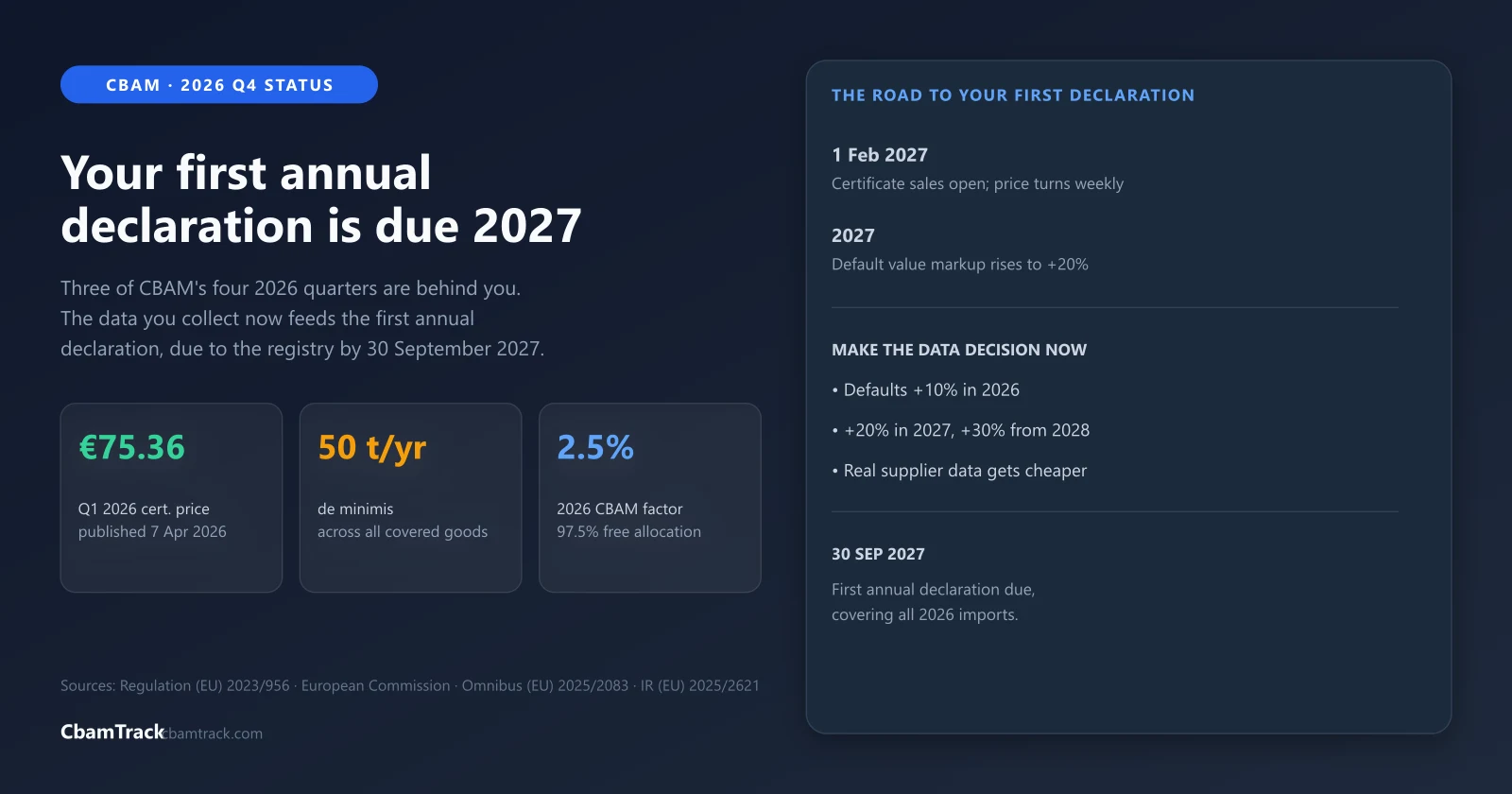
By the time you read this, three of CBAM's four 2026 quarters are behind you. The permanent regime has been running since January 1, 2026, and the data you collect now isn't a dry run. It feeds the first annual declaration, due to the CBAM registry by 30 September 2027.
Most importers treat this as a distant deadline. It's closer than it feels. This post walks through the 2026 data picture quarter by quarter, what the certificate price mechanism does, and the handful of decisions that decide whether your first declaration is clean or messy.
The 2026 data year, at a glance
The permanent phase collects and prices carbon on a straightforward rhythm:
| Quarter | What happens | When |
|---|---|---|
| Q1 2026 | First quarterly certificate price published at €75.36/tCO₂ | 7 April 2026 |
| Q2 2026 | Import data collected; next price set | July 2026 |
| Q3 2026 | Import data collected; next price set | Oct 2026 |
| Q4 2026 | Final quarter of the declaration year | Jan 2027 |
| 2027 | Certificate sales open 1 February; first annual declaration due 30 September 2027 | Feb & Sep 2027 |
The one figure here that's fixed and published is the Q1 2026 certificate price of €75.36/tCO₂ (European Commission, published 7 April 2026). Everything after it follows the same calculation, just with newer auction data.
How the certificate price actually moves
In 2026 the CBAM certificate price is a quarterly average of EU ETS auction prices. From February 2027 that switches to a weekly average. That's a real change, not a footnote:
- 2026: each quarter, one price applies to that quarter's imports.
- 2027 onwards: the price you pay tracks the ETS auction market week to week, so your cost moves with the market in near real time.
It means 2026 is the last year you get the relative stability of a three-month price. If you're modelling CBAM cost for 2027, build in price volatility from the start.
What counts as data in 2026
For every imported batch you need the same core fields, and they're not optional:
- CN code (8-digit) and quantity in tonnes
- Country of origin
- Production route (BF-BOF, EAF, DRI-EAF, etc.)
- Direct emissions per tonne
- Indirect emissions from electricity (report only for steel, aluminium, hydrogen, electricity; chargeable for cement and fertilisers under Annex II)
- Any carbon price already paid in the country of origin
Under Reporting Regulation IR (EU) 2025/2621, the EU provides default values (around 13,566 across 120+ countries) when actual data isn't available. Defaults are set to reflect worst-case production, and they carry a markup:
| Year | Default value markup |
|---|---|
| 2026 | +10% |
| 2027 | +20% |
| 2028+ | +30% (fertilisers always +1%) |
The direction is hard to miss. Defaults get more expensive every year, so the earlier you shift suppliers onto real measured data, the cheaper your 2027 declaration gets.
The benchmark subtraction you can't skip
In 2026 the CBAM factor sits at 97.5%, so importers still receive 97.5% of the sector benchmark as free allocation. The chargeable share of the gap between embedded emissions and that benchmark is the complement — 2.5% in 2026 — not the factor itself.
Payable = (Embedded Emissions − Benchmark × CBAM Factor) × Certificate Price
The benchmark subtraction matters more than most summaries admit. Take steel BF-BOF with a 1.370 tCO₂e/t benchmark, a 97.5% CBAM factor in 2026 (so a 2.5% chargeable share), €75.36 price, and 2.0 tCO₂e/t actual emissions:
- Benchmark deduction: 1.370 × 0.975 = 1.336 tCO₂e/t
- Chargeable: 2.0 − 1.336 = 0.664 tCO₂e/t
- 2026 cost: 0.664 × €75.36 ≈ €50.04/t
Run the same batch on default values instead of actual data and the chargeable gap roughly quadruples. That single line in the formula is why supplying real data is worth supplier-relations effort now, not in 2028.
The de minimis that quietly exempts most importers
The Omnibus Regulation (EU) 2025/2083 introduced a 50-tonne-per-year threshold across all covered goods. Below it you're exempt from authorisation, declarations, and certificate purchase altogether. The cap doesn't apply to electricity or hydrogen.
It's estimated to exempt around 90% of importers, but here's the catch: the 50 tonnes is measured across all your CBAM goods combined, per year. A business importing 30 tonnes of steel and 30 tonnes of aluminium crosses 60 and is fully in scope. If you're near the line, track the cumulative total, not per-product tonnage.
Your first annual declaration in one paragraph
The declaration is due 30 September 2027 and covers all 2026 imports. It's an aggregate of the four quarters, so the quality of your submission is decided by how you logged data in 2026, not September 2027. Certificate sales open 1 February 2027, so you buy against the balance during the year and reconcile at declaration. Because 2026 is the first year of the definitive regime, the operative penalty is €100 per tonne of CO₂e for failure to surrender certificates (Regulation (EU) 2023/956, Article 26) — not the €10–€50 range, which belonged to the transitional phase (IR (EU) 2023/1773, Article 16(1)–(3)) and applied only to 2023–2025. Either way, this isn't a filing you want to build overnight.
The short version
- The Q1 2026 certificate price of €75.36/tCO₂ is published and fixed; later quarters follow the same quarterly-average method.
- From February 2027 the price turns weekly, so 2026 is your last stable-price year.
- Default value markups climb +10% → +20% → +30%, so real supplier data gets cheaper every year.
- The benchmark subtraction in the CBAM formula is the single biggest lever on your actual cost.
- The 50-tonne de minimis exempts most importers, but it's cumulative across all covered goods.
- Your first declaration on 30 September 2027 is only as good as the data you log this year.
Related: What Data Does Your EU Customer Need? | CBAM Certificate Cost Formula | CBAM Compliance: What to Do Right Now | EU ETS Free Allocation & the CBAM Factor
Frequently Asked Questions
When is the first CBAM annual declaration due?
30 September 2027, covering all 2026 imports.
When can I buy CBAM certificates?
Sales open 1 February 2027. In 2026 the price is a quarterly average of EU ETS auctions; from February 2027 it becomes a weekly average.
Do default values always apply if I don't have supplier data?
No. You can use actual data where suppliers provide it. Defaults apply where data is missing, and they carry a markup rising from +10% in 2026 to +30% from 2028.
Am I exempt if my imports are small?
If you import under 50 tonnes per year across all covered goods, Omnibus (EU) 2025/2083 exempts you from authorisation, declaration, and certificates. Electricity and hydrogen are not covered by the threshold.
Regulation status
| Field | Value |
|---|---|
| Last reviewed | 2026-09-09 |
| Based on | Regulation (EU) 2023/956 (incl. Article 26), IR (EU) 2025/2621, IR (EU) 2025/2620, Omnibus (EU) 2025/2083, IR (EU) 2023/1773 (transitional, historical) |
| Applies to | CBAM permanent phase (2026+), first declaration year (2026) |
References
- EU Regulation 2023/956
- IR (EU) 2025/2621 (default values)
- European Commission, Price of CBAM certificates
- European Commission, CBAM
- Omnibus Regulation (EU) 2025/2083
Last updated: September 9, 2026
Related: CBAM 2026 in practice: TARIC and authorisation | Reduce CBAM Costs | CBAM Default Values & Markups
This article was researched and written with AI assistance. Figures and regulatory references are cross-checked against official EU sources (EUR-Lex, European Commission CBAM page) and updated when the rules change.
R. Emrah Gökkaya
I built CbamTrack because I saw SME exporters struggling with spreadsheets and confusing regulations. Every article here reflects what I've learned implementing IR 2025/2621-compliant calculations, integrating live EU ETS pricing, and building the emission factor database that powers our platform.
View full author bio →Ready to simplify your CBAM compliance?
Subscribe today and generate your first CBAM report in minutes.