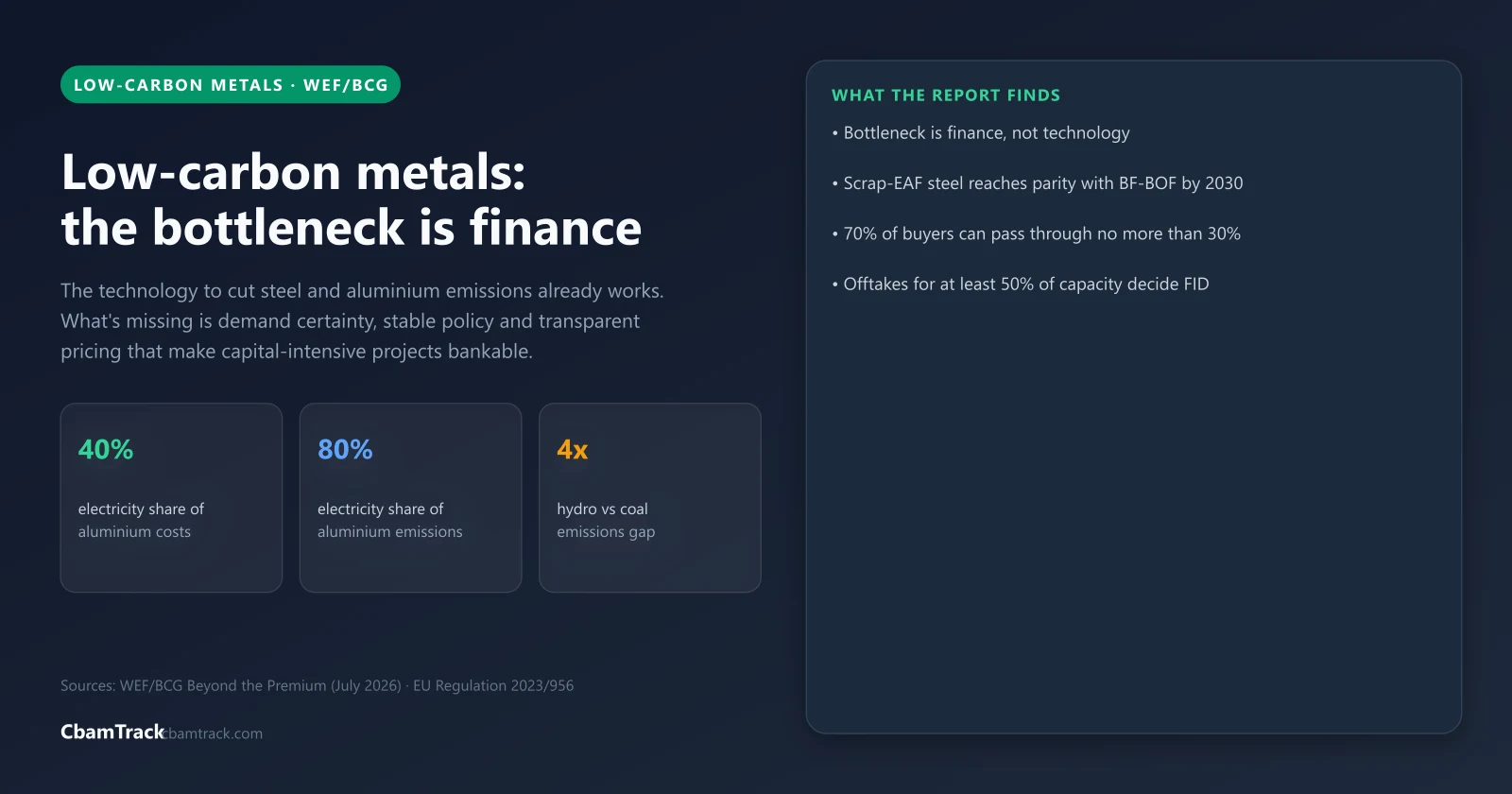
Low-Carbon Metals: Finance, Not Technology
Key Takeaways
- This guide covers industry guide reporting requirements based on IR (EU) 2025/2621 and EU Regulation 2023/956
- All emission factors and CN codes referenced are verified against the latest EU implementing regulations
- Practical steps and common mistakes are drawn from hands-on implementation experience with the CbamTrack platform
From the team behind CbamTrack
We built this guide based on hands-on experience implementing CBAM compliance for SME importers. The calculations and workflows described here power our own platform — this is not theory, it's what we ship.
The core finding
WEF and BCG put it plainly in their July 2026 report:
"At a challenging moment for the low-carbon metals sector, the key bottleneck to decarbonizing steel and aluminium is finance, not technology." WEF/BCG, "Beyond the Premium: The Economics of Low-Carbon Metals" (July 2026)
That single sentence carries the whole argument. The technology to make greener steel and aluminium already works. What's missing is everything that makes a capital-intensive project bankable: long-term demand certainty, stable policy, and pricing that buyers and lenders can trust.
What the last year did to metal prices
The past 12 months were rough on industrial metals:
| Event | Impact |
|---|---|
| US tariffs (50% on steel/aluminium articles) | Pressure on producers already facing high energy costs |
| Middle East conflict | Aluminium prices soared about 40% to over $3,500/t (June 2026) |
| European gas price spike | Gas futures briefly doubled |
EU regulation is pushing the economics the other way:
- The phased removal of free allowances under the EU ETS, plus tightening CBAM, will make carbon-intensive blast furnace (BF-BOF) steel considerably more expensive by 2030
- Lower-carbon scrap-EAF steel reaches cost-parity as a result
- The Industrial Accelerator Act could add 9 million tonnes of low-carbon steel demand in its first year (2028 to 2029)
- Vehicle fleet emissions regulation amendments could generate about 11 million tonnes of near-zero-emissions steel demand per year by 2035
So one set of forces raises the cost of doing nothing, and another makes the case for switching routes stronger.
Aluminium lives by its electricity
Electricity is the defining cost and emissions driver for aluminium:
| Measure | Figure |
|---|---|
| Electricity share of total production costs | Up to 40% |
| Electricity share of industry emissions | About 80% |
| Hydro-powered primary aluminium (Quebec/Scandinavia) | About 4 to 5 tCO2e/t (cradle-to-gate) |
| Coal-powered smelting (China) | About 17 to 18 tCO2e/t |
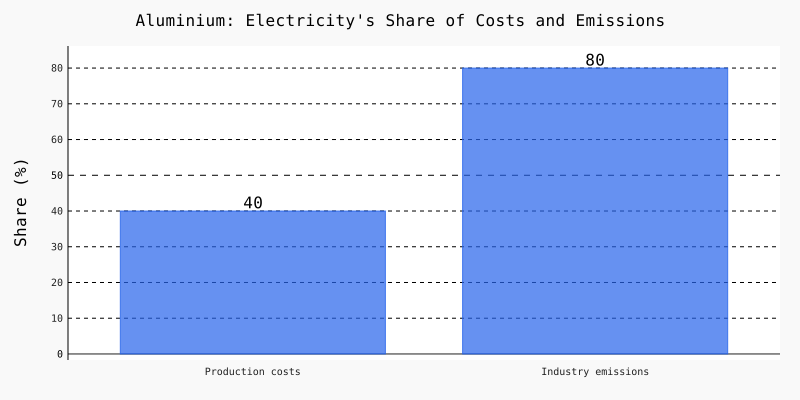
"For aluminium, electricity accounts for up to 40% of total production costs and roughly 80% of the industry's emissions." WEF/BCG, "Beyond the Premium" (July 2026)
The gap between the hydro and coal routes is around 4x, and closing it is the industry's core decarbonisation problem. CBAM does not reward the cleaner route directly, though. Under Annex II, indirect electricity emissions are reported but not charged, so what matters for your certificate cost is the smelting route, not how clean the local grid is.
Steel: four routes, four different fates
| Route | Where it stands |
|---|---|
| BF-BOF (conventional) | Becoming considerably more expensive by 2030 as free allowances phase out |
| Scrap-EAF (recycled) | Already cost-competitive in the US; needs policy support in Europe |
| NG-DRI-EAF (natural gas) | Cost-competitive in the US (cheap gas); needs support in Europe |
| H2-DRI-EAF (near-zero, FMC-compliant) | Significant hurdles in both US and Europe due to green hydrogen cost uncertainty |
Two first-movers show what it takes. GravitHy in France and Stegra in Sweden both combined government grants, loan guarantees and concessional debt with long-term demand. The detail that decides whether a project reaches final investment decision is whether the developer locks in at least half of initial production capacity through advance offtakes. Permitting is the other threat. Grid connections sometimes take more than a decade to clear.
Buyers can't pass the premium on
"A post-roundtable survey found that 70% of respondents could pass through no more than 30% of additional low-carbon costs to end-customers." WEF/BCG, "Beyond the Premium" (July 2026)
The green premium is real, but buyers are mostly swallowing it themselves:
| Point | Detail |
|---|---|
| Buyers who can pass through no more than 30% of low-carbon costs | 70% |
| Aluminium trading | Global commodity; abatement costs obscured by benchmark/regional premium/billet/freight layers |
| Steel pricing | More directly linked to production costs; direct negotiation possible |
That 70% figure is why offtake structures matter more than a green marketing story. The buyer absorbs the gap today because the end customer won't.
The problem with competing definitions
The London Metal Exchange set its sustainable aluminium threshold below 8 tCO2e/t. That is deliberately loose. A threshold set too tight means trading volumes never get off the ground, so the LME cast the net wide and plans to tighten it over time.
"Without a shared definition, products cannot be compared, prices cannot be trusted, and the market cannot scale." Standards-setting organisation representative, WEF roundtable (2026)
The problem underneath is competing definitions. Agree on what "low-carbon" means and the market can grow. Leave it vague and every producer trades on its own numbers.
What actually moves projects
| Model | Example |
|---|---|
| Long-term offtake agreements synchronized with investment milestones | Improves bankability for suppliers |
| Co-investment in production infrastructure | Apple's stake in the Elysis near-zero aluminium JV |
| Reframing the green premium | Not a cost, but an investment in resilience, supply security and future carbon-risk mitigation |
| Designing out excess metal, more scrap, circularity loops | Efficiency-based approaches gaining traction |
The short version
- The bottleneck is finance, not technology: bankability, not capability
- EU regulation (ETS free-allowance phase-out plus CBAM) is making scrap-EAF steel cost-competitive by 2030
- Aluminium: electricity is 40% of costs and 80% of emissions; the hydro vs coal gap is around 4x
- 70% of buyers can pass through no more than 30% of the green premium
- Advance offtakes covering at least 50% of capacity are decisive for FID on low-carbon projects
Related: CBAM Reporting for Steel Importers | CBAM Reporting for Aluminium Companies | Reduce CBAM Costs
Frequently asked questions
When does low-carbon steel reach cost parity?
In Europe, scrap-EAF and NG-DRI-EAF reach parity with BF-BOF as free allowances phase out toward 2030. H2-DRI-EAF remains the hardest to make competitive.
What's the LME sustainable aluminium threshold?
Below 8 tCO2e per tonne of primary aluminium produced.
How does CBAM interact with this?
CBAM prices embedded carbon at the border, reinforcing the economics of low-carbon routes. For aluminium, only direct smelting emissions are charged under Annex II, so technology choice matters more than electricity source.
Regulation status
| Field | Value |
|---|---|
| Last reviewed | 2026-09-21 |
| Based on | WEF/BCG "Beyond the Premium" (July 2026), EU Regulation 2023/956 |
| Applies to | CBAM permanent phase (2026+) |
References
- World Economic Forum, Beyond the Premium: The Economics of Low-Carbon Metals (July 2026)
- First Movers Coalition
- EU Regulation 2023/956
- European Commission, Industrial Accelerator Act
Last updated: September 2026 | Sources: WEF/BCG "Beyond the Premium" (July 2026), First Movers Coalition roundtable
This article was researched and written with AI assistance. Figures and regulatory references are cross-checked against official EU sources (EUR-Lex, European Commission CBAM page) and updated when the rules change.
R. Emrah Gökkaya
I built CbamTrack because I saw SME exporters struggling with spreadsheets and confusing regulations. Every article here reflects what I've learned implementing IR 2025/2621-compliant calculations, integrating live EU ETS pricing, and building the emission factor database that powers our platform.
View full author bio →Ready to simplify your CBAM compliance?
Subscribe today and generate your first CBAM report in minutes.