CBAM 2026/1740: Corrected Default Values
Key Takeaways
- This guide covers compliance reporting requirements based on IR (EU) 2025/2621 and EU Regulation 2023/956
- All emission factors and CN codes referenced are verified against the latest EU implementing regulations
- Practical steps and common mistakes are drawn from hands-on implementation experience with the CbamTrack platform
From the team behind CbamTrack
We built this guide based on hands-on experience implementing CBAM compliance for SME importers. The calculations and workflows described here power our own platform — this is not theory, it's what we ship.
Your 2026 numbers were built on a table that no longer exists
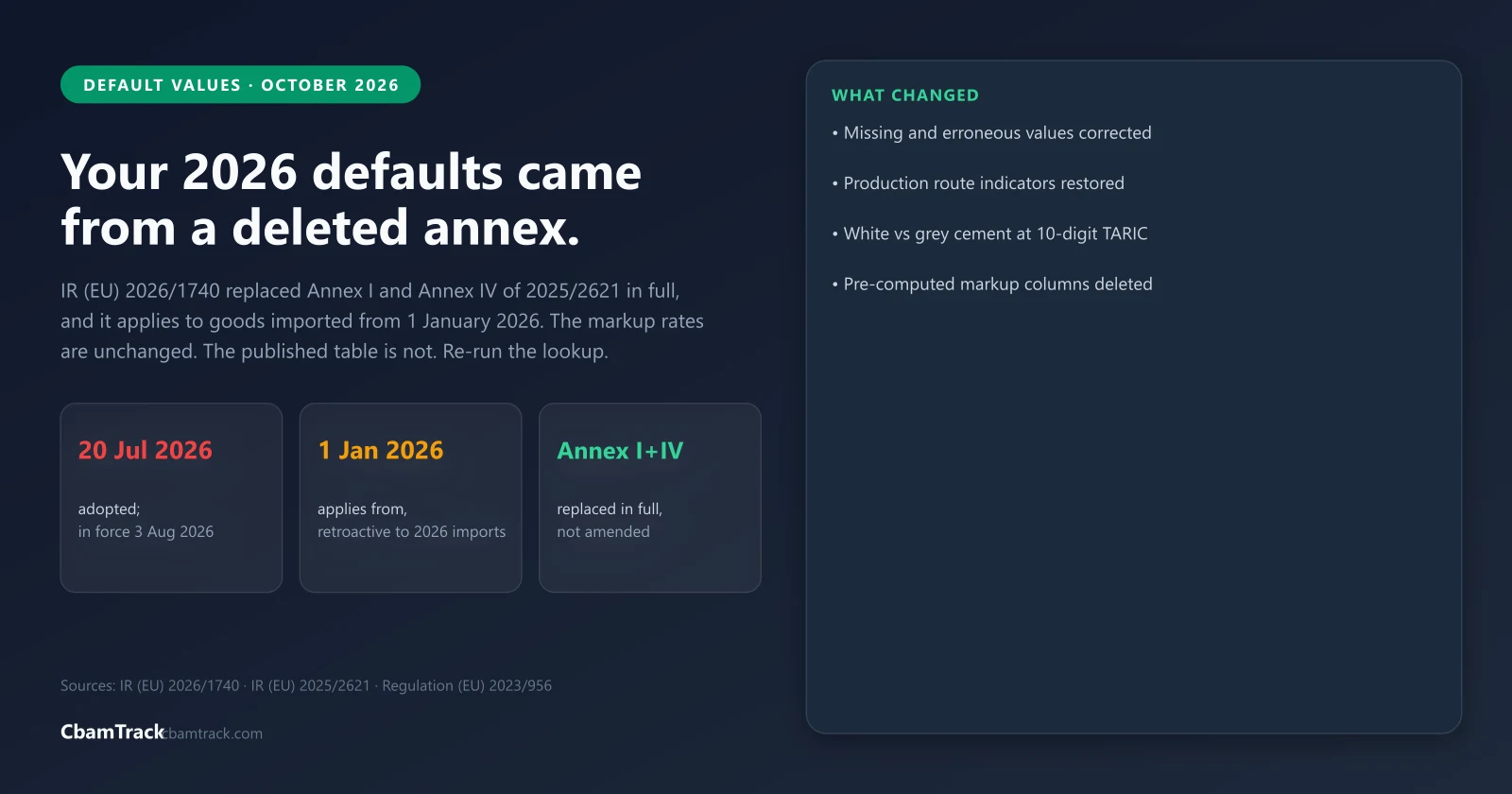
If you modelled CBAM cost for 2026 imports, you used a default value from Annex IV of Commission Implementing Regulation (EU) 2025/2621. That annex is gone. Commission Implementing Regulation (EU) 2026/1740 replaced Annex I and Annex IV of 2025/2621 in full, and it applies to goods imported from 1 January 2026.
The regulation was adopted on 20 July 2026, published in the Official Journal on 31 July 2026, and entered into force on 3 August 2026. The retroactive start date is the part that matters for your 2026 filings.
This is not a clarification. The annexes were replaced, not amended, and several of the corrections change which number you should have used for a specific CN code and country. There is also a structural change to how the markup is derived that affects anyone who calculated the markup by hand.
| Milestone | Date |
|---|---|
| Adopted | 20 July 2026 |
| Published in the Official Journal | 31 July 2026 |
| Entered into force | 3 August 2026 |
| Applies to goods imported from | 1 January 2026 |
| Replaces | Annex I and Annex IV of IR (EU) 2025/2621, in full |
The Commission's CBAM legislation and guidance page remains the index to the consolidated text, and the Commission has said a consolidated version of 2025/2621 will follow.
Four kinds of error it fixes
The Commission grouped the corrections into four categories. Each one maps to a different reason a default value could be wrong.
Some country and product combinations had no entry at all, so importers fell back to a wider average than they should have. Albania, Guatemala and Zambia had country data reinstated, and the missing precursor values for aluminium were restored. Other figures in the annex were simply wrong, described in the source material as transcription errors.
The third category is the one that quietly breaks lookups. Where the default depended on how the material was made, and the annex did not record the route, the value could not be applied correctly. The production route indicators that the correction restores are what let you pick the right number in the first place.
Then there are the customs distinctions, and these have operational consequences. Cement and clinker are now distinguished between white and grey at 10-digit TARIC level rather than 8-digit CN level. Kaolinic clay is restricted to calcined kaolinic clay, TARIC 2507 00 80 80.
That last set matters because a default is only correct if the code you are declaring against is the code the default was built for. If your customs classification and the annex disagreed, you were applying a value to a product it was never measured against.
The pre-computed markup columns were deleted
The old annex published the markup for 2026, 2027 and 2028 as pre-computed columns. Regulation 2026/1740 deleted those columns. The markup is now calculated dynamically inside the CBAM Registry, derived from the base value of total emissions.
The markup rates themselves did not change. They remain the schedule set out in IR (EU) 2025/2621:
| Year | Markup on the default value |
|---|---|
| 2026 | +10% |
| 2027 | +20% |
| 2028 | +30% |
So if you computed the markup by multiplying a published annex figure by 1.10 for 2026, the arithmetic is the same. What has changed is that the Registry now produces the figure, and the published table no longer shows it.
The practical effect is that you cannot sanity-check the Registry's markup against a published column any more, because there is no published column. The mechanics of the markup and how it applies to sectors such as fertilisers are set out in CBAM default values and markups.
Product-level corrections worth checking against your file
Two country code corrections were called out specifically, and they are the kind of detail that silently produces a wrong figure when it is wrong.
- Taiwan: CN codes 7218 to 7223
- Other countries and territories: CN 7226 20 00
If you declared a Taiwanese flat steel product under a code in the 7218 to 7223 range, or used the catch-all for other countries and territories under 7226 20 00, verify the corrected value applies to your shipment.
Beyond the country code fixes, the reinstated aluminium precursor values and the reinstated country data for Albania, Guatemala and Zambia are the two changes most likely to move a real number rather than a classification.
The corrected spreadsheet is not the legal text
On 10 August 2026 the Commission published a corrected Excel file. It is for information purposes only. The legally binding values sit in IR (EU) 2025/2621 as corrected by 2026/1740, and a consolidated version of 2025/2621 is still to follow.
This trips people up, so it is worth being blunt: use the corrected spreadsheet for orientation, and use the regulation for anything that ends up in a declaration. If the two ever appear to disagree, the regulation governs. The corrected implementing regulation on EUR-Lex is the citation to hold on to.
Two guidance drops landed after the regulation
The Commission published ten new guidance documents for non-EU installation operators on 14 August 2026, and guidance on CBAM verification and accreditation for verifiers and National Accreditation Bodies on 24 August 2026.
Both matter to different sides of the same declaration. The operator guidance is what a supplier outside the EU should be working from when producing embedded emissions data. The verification guidance is what determines how that data gets checked, which in turn decides whether it can replace a default value. For the verification side, see CBAM 2026 in practice.
The defaults nobody could defend
The replacement did not arrive in a vacuum. Researchers had already flagged specific default values as indefensible on their face, months before the Commission acted.
A 2026 discussion paper from the Research Institute of Economy, Trade and Industry (RIETI) in Japan examined published CBAM default values against published emissions intensity data. Note that this is institutional working paper research, and the figures below describe the December 2025 defaults that 2026/1740 has now replaced. They are included because they show what the correction was correcting.
On cement clinker, CN 2523 10 00, the paper found the top five import origins were Türkiye, Algeria, Egypt, Saudi Arabia and Morocco. A JRC 2023 report had put the emissions intensity of all five at roughly 0.87 to 0.89 tCO2/t. The December 2025 defaults did not look like that. This is the clearest documented case in the paper of a default value that was indefensible on its face, which is why it is set out here at length.
| Origin | JRC 2023 reported intensity | December 2025 default value |
|---|---|---|
| Morocco | 0.87 to 0.89 tCO2/t | 0.90 tCO2/t |
| Algeria | 0.87 to 0.89 tCO2/t | 1.28 tCO2/t |
| Egypt | 0.87 to 0.89 tCO2/t | 1.27 tCO2/t |
| Türkiye | 0.87 to 0.89 tCO2/t | 1.41 tCO2/t (10-country average, no country value set) |
| Saudi Arabia | 0.87 to 0.89 tCO2/t | 1.41 tCO2/t (10-country average, no country value set) |
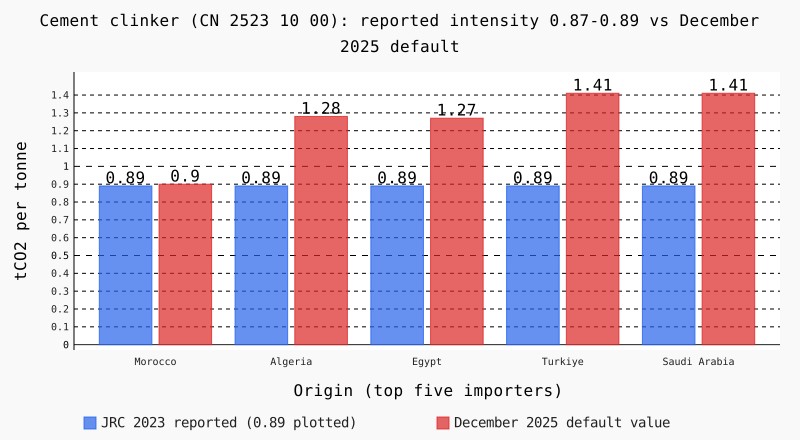
Türkiye and Saudi Arabia had no country-specific value assigned, so the average of the ten worst-performing countries applied instead. The paper's objection was that dry-process kilns dominate in these four countries, and a process difference cannot plausibly explain a gap of that size between 0.90 and 1.41 tCO2/t. Its conclusion was that actual intensity is probably considerably lower, and that using actual emissions instead of the default could bring the burden down to roughly Morocco's level.
The same paper raised a transparency problem over the Indonesian figures. Indonesia's pig iron default was 7.92 tCO2/t, more than double the 3.48 tCO2/t average of the ten worst countries, and the Indonesian flat-rolled default reached 8.23 tCO2/t, high enough that the carbon cost approaches the unit price of the goods themselves. Indonesia and China are the two countries the paper singles out for defaults sitting far above the benchmarks used during the transitional phase, which CBAM default values and markups sets out code by code.
The paper's stated reason for doubting that number is a disclosure gap rather than an arithmetic error: the Commission has published an outline of the calculation basis but has not made the underlying data sources for each product category public, so the derivation of the Indonesian value cannot be independently checked. That point is our rendering of the Japanese original, not a quoted passage.
Indonesia's nickel pig iron is the paper's leading candidate explanation, since the country has large nickel resources and nickel pig iron has a high emissions intensity. The paper notes that the methodology regulation treats nickel pig iron specially where nickel content is under 10 per cent, which makes the link plausible but unconfirmed.
Whether the corrected annex moved the Indonesian figures is not something the published text lets us tell you. Check your CN codes against the corrected annex rather than assuming the correction helped you.
What to do with your 2026 numbers
Four actions, in the order that reduces rework.
- Pull the CN code, country of origin, production route and default value you used for each 2026 line. You need the inputs, not the totals.
- Re-run the lookup against IR 2025/2621 as corrected by 2026/1740, not the original annex. If your tooling holds a local copy of the old annex values, that copy is now wrong.
- Check the two customs changes specifically. If you declared white or grey cement or clinker, or kaolinic clay, confirm your TARIC code is at the right digit and in the right category.
- Stop calculating the markup by hand. Let the Registry produce it, since the published columns no longer exist to check against.
If your 2026 model sits in a spreadsheet, this is the moment to replace the hardcoded default table with a dated reference to the correcting regulation, so the next replacement is a version change rather than an audit. On the data collection side, defaults are the fallback when a supplier cannot give you a figure, which makes collecting carbon data from suppliers the lever that actually moves your number. The reporting timeline those numbers have to survive is in CBAM 2026 Q4 importer status.
What to take away
- IR (EU) 2026/1740 replaced both annexes of IR 2025/2621 in full, not a section of them.
- It applies retroactively to goods imported from 1 January 2026, so 2026 models built on the old annexes need re-running.
- The pre-computed 2026, 2027 and 2028 markup columns were deleted. The rates are unchanged at +10%, +20% and +30%, and the Registry now derives the figure.
- White versus grey cement and clinker are distinguished at 10-digit TARIC, and kaolinic clay is limited to calcined clay under TARIC 2507 00 80 80.
- The corrected Excel file published on 10 August 2026 is informational. The regulation is what governs a declaration.
- Defaults are not automatically conservative. Some were set well above the reported intensity of the country concerned, as Türkiye and Saudi Arabia clinker showed.
Related: CBAM default values and markups | CBAM 2026 in practice: TARIC and authorisation | Collecting carbon data from suppliers | CBAM 2026 Q4 importer status | EU ETS free allocation and the CBAM factor
Frequently asked questions
Do I have to redo my 2026 CBAM calculation?
If your 2026 figure used a default value from Annex IV of IR (EU) 2025/2621 as originally published, then yes, the value it should have used has changed. The regulation applies to goods imported from 1 January 2026 regardless of when you ran the calculation. If your 2026 declaration used actual verified emissions throughout, the correction to default values does not touch it.
Does the correction change the CBAM markup percentage?
No. The markup schedule is unchanged. It is still:
- 2026: +10%
- 2027: +20%
- 2028: +30%
What changed is that the pre-computed columns in the annex were deleted, and the markup is now calculated inside the CBAM Registry from the base value of total emissions.
There is one category-specific exception to be aware of when you compare figures across sectors: fertilisers carry a 1% markup, not 10%. The general schedule above applies to almost all goods, and the fertiliser rate is set separately. If you are reading a fertiliser cost per tonne somewhere and comparing it against a steel or cement figure, that difference in markup is part of why the numbers are not directly comparable. CBAM default values and markups works through the sector rates.
Which file should I use, the corrected spreadsheet or the regulation?
The regulation. The corrected Excel file published on 10 August 2026 is explicitly for information purposes. The legally binding values are in IR (EU) 2025/2621 as corrected by IR (EU) 2026/1740, and a consolidated version has not yet been published.
Does this affect cement and clay declarations specifically?
Yes, and these are the changes to check first. White and grey cement and clinker are now distinguished at 10-digit TARIC level rather than 8-digit CN level, and kaolinic clay is restricted to calcined kaolinic clay under TARIC 2507 00 80 80. A default applied to the wrong code is a default applied to a product it was never measured against.
Will the corrected defaults lower my cost?
It depends entirely on the country and product, and the direction cannot be read off the published texts. What the correction demonstrably did was fix errors, restore values that had been missing, and tighten product identification. Whether your specific line went up or down is a lookup against the corrected annex, not something to infer. Re-run it rather than assuming the correction helped.
Regulation status
| Field | Value |
|---|---|
| Last reviewed | 2026-09-27 |
| Based on | Regulation (EU) 2023/956, IR (EU) 2025/2621, IR (EU) 2026/1740, IR (EU) 2023/1773, Omnibus (EU) 2025/2083 |
| Applies to | CBAM permanent phase (2026+) |
References
- IR (EU) 2026/1740, corrected default values, EUR-Lex
- IR (EU) 2025/2621, default values, EUR-Lex
- EU Regulation 2023/956, the CBAM Regulation
- European Commission, CBAM legislation and guidance
- RIETI Discussion Paper 26-J-034, CBAM default values and emissions intensity
Last updated: October 2026 | Sources: IR (EU) 2026/1740, IR (EU) 2025/2621, Regulation (EU) 2023/956
Important Financial Disclaimer
The financial figures, cost estimates, and compliance scenarios discussed in this article are for informational purposes only. Actual CBAM liability depends on your specific import profile, verified emission data, and regulatory interpretations. Consult a qualified CBAM advisor or customs professional before making compliance decisions.
This article was researched and written with AI assistance. Figures and regulatory references are cross-checked against official EU sources (EUR-Lex, European Commission CBAM page) and updated when the rules change.
R. Emrah G�kkaya
I built CbamTrack because I saw SME exporters struggling with spreadsheets and confusing regulations. Every article here reflects what I've learned implementing IR 2025/2621-compliant calculations, integrating live EU ETS pricing, and building the emission factor database that powers our platform.
View full author bio →Ready to simplify your CBAM compliance?
Subscribe today and generate your first CBAM report in minutes.